

Jin Mao Jing Tang | Shanghai PTArchitects | Architect of the Year Awards 2025
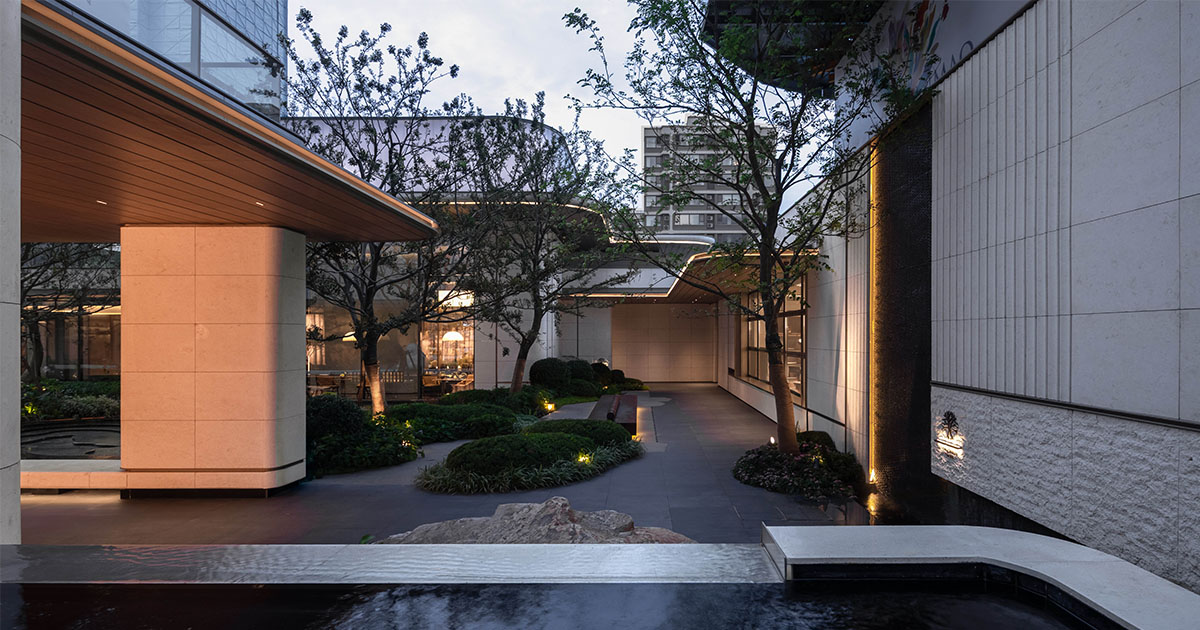
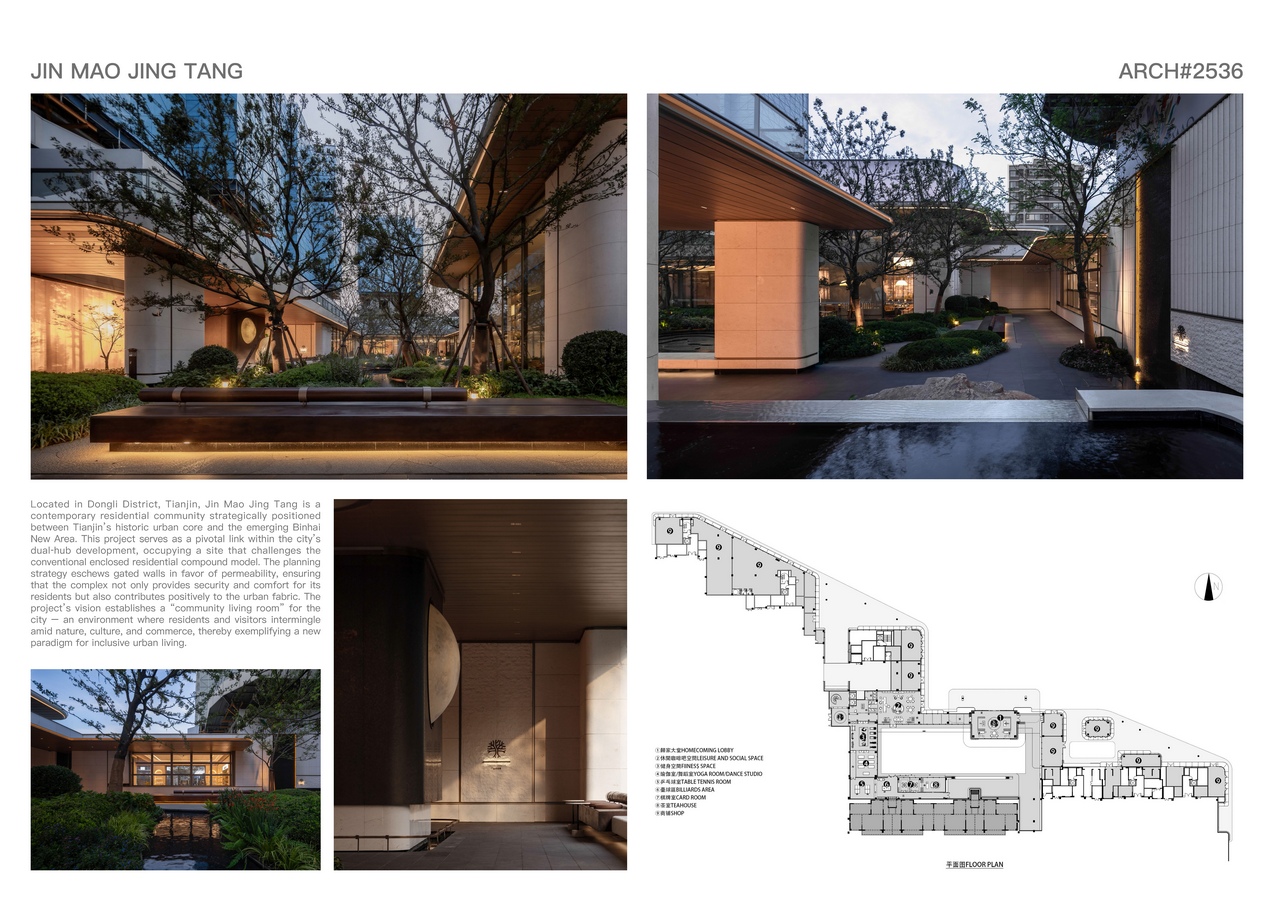
Shanghai PTArchitects: Winner of the Architect of the Year Awards 2025. Located in Dongli District, Tianjin, Jin Mao Jing Tang is a contemporary residential community strategically positioned between Tianjin’s historic urban core and the emerging Binhai New Area. This project serves as a pivotal link within the city’s dual‐hub development, occupying a site that challenges the conventional enclosed residential compound model. The planning strategy eschews gated walls in favor of permeability, ensuring that the complex not only provides security and comfort for its residents but also contributes positively to the urban fabric. The project’s vision establishes a “community living room” for the city – an environment where residents and visitors intermingle amid nature, culture, and commerce, thereby exemplifying a new paradigm for inclusive urban living.

Challenge & Context
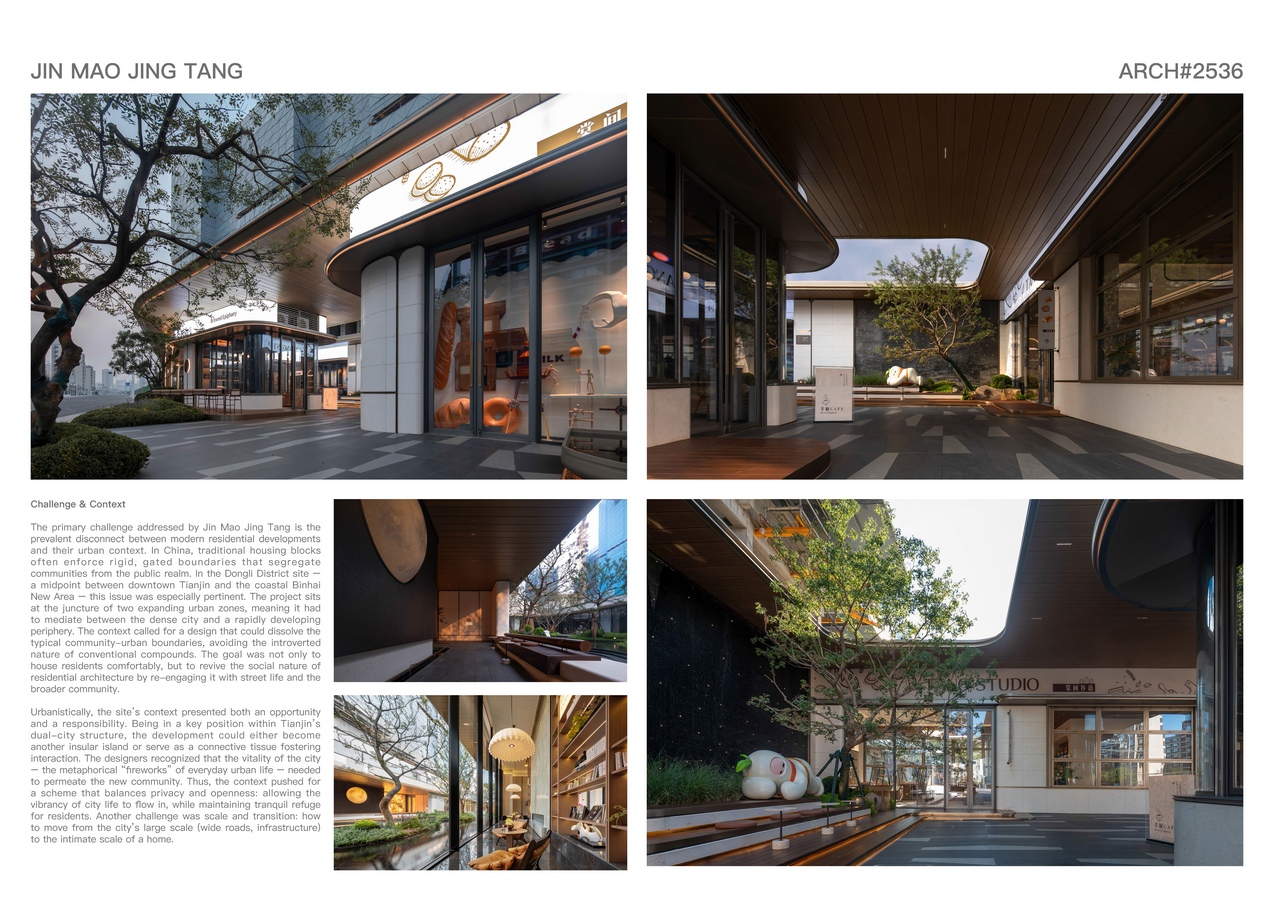
The primary challenge addressed by Jin Mao Jing Tang is the prevalent disconnect between modern residential developments and their urban context. In China, traditional housing blocks often enforce rigid, gated boundaries that segregate communities from the public realm. In the Dongli District site – a midpoint between downtown Tianjin and the coastal Binhai New Area – this issue was especially pertinent. The project sits at the juncture of two expanding urban zones, meaning it had to mediate between the dense city and a rapidly developing periphery. The context called for a design that could dissolve the typical community-urban boundaries, avoiding the introverted nature of conventional compounds. The goal was not only to house residents comfortably, but to revive the social nature of residential architecture by re-engaging it with street life and the broader community.
Urbanistically, the site’s context presented both an opportunity and a responsibility. Being in a key position within Tianjin’s dual-city structure, the development could either become another insular island or serve as a connective tissue fostering interaction. The designers recognized that the vitality of the city – the metaphorical “fireworks” of everyday urban life – needed to permeate the new community. Thus, the context pushed for a scheme that balances privacy and openness: allowing the vibrancy of city life to flow in, while maintaining tranquil refuge for residents. Another challenge was scale and transition: how to move from the city’s large scale (wide roads, infrastructure) to the intimate scale of a home.
Design Solution
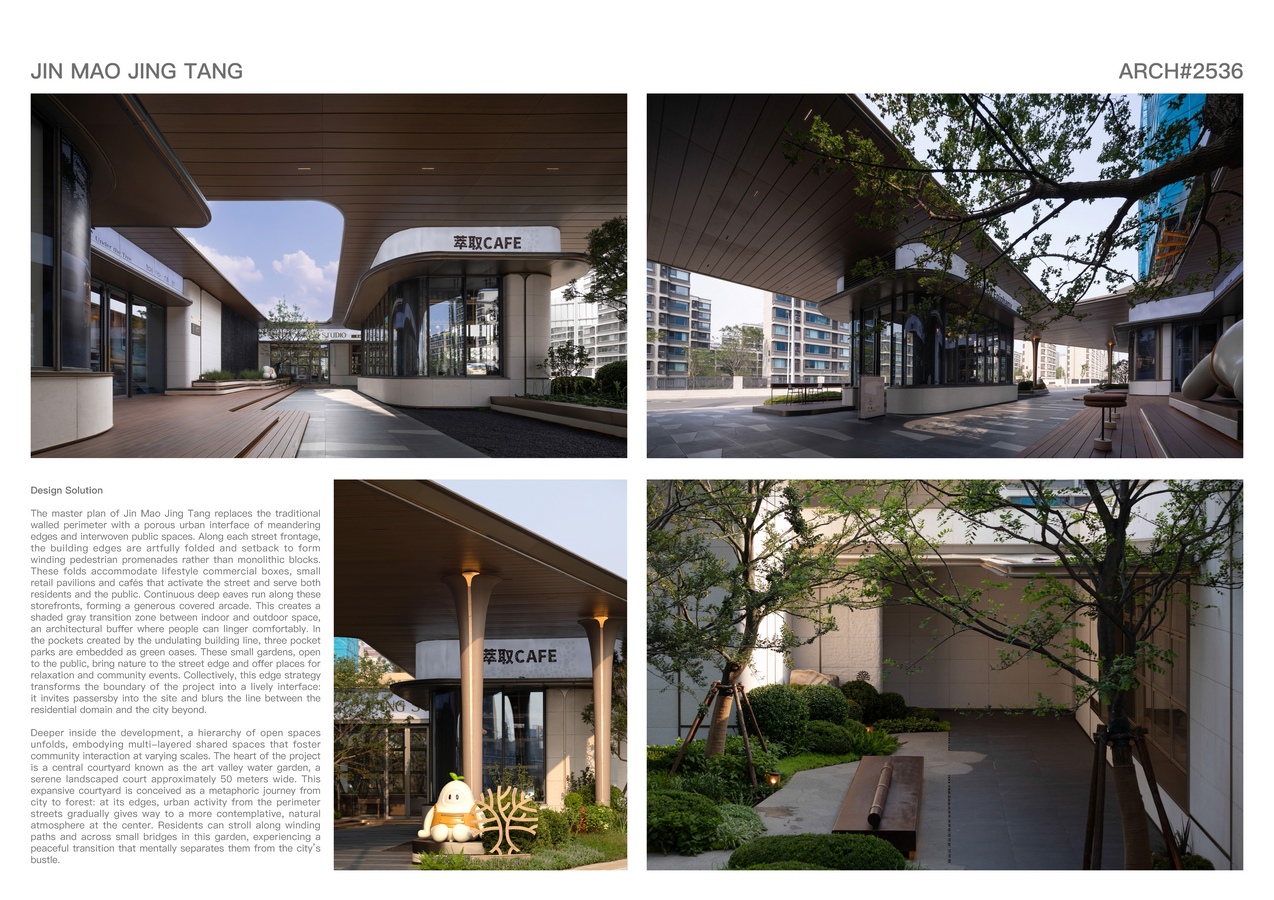
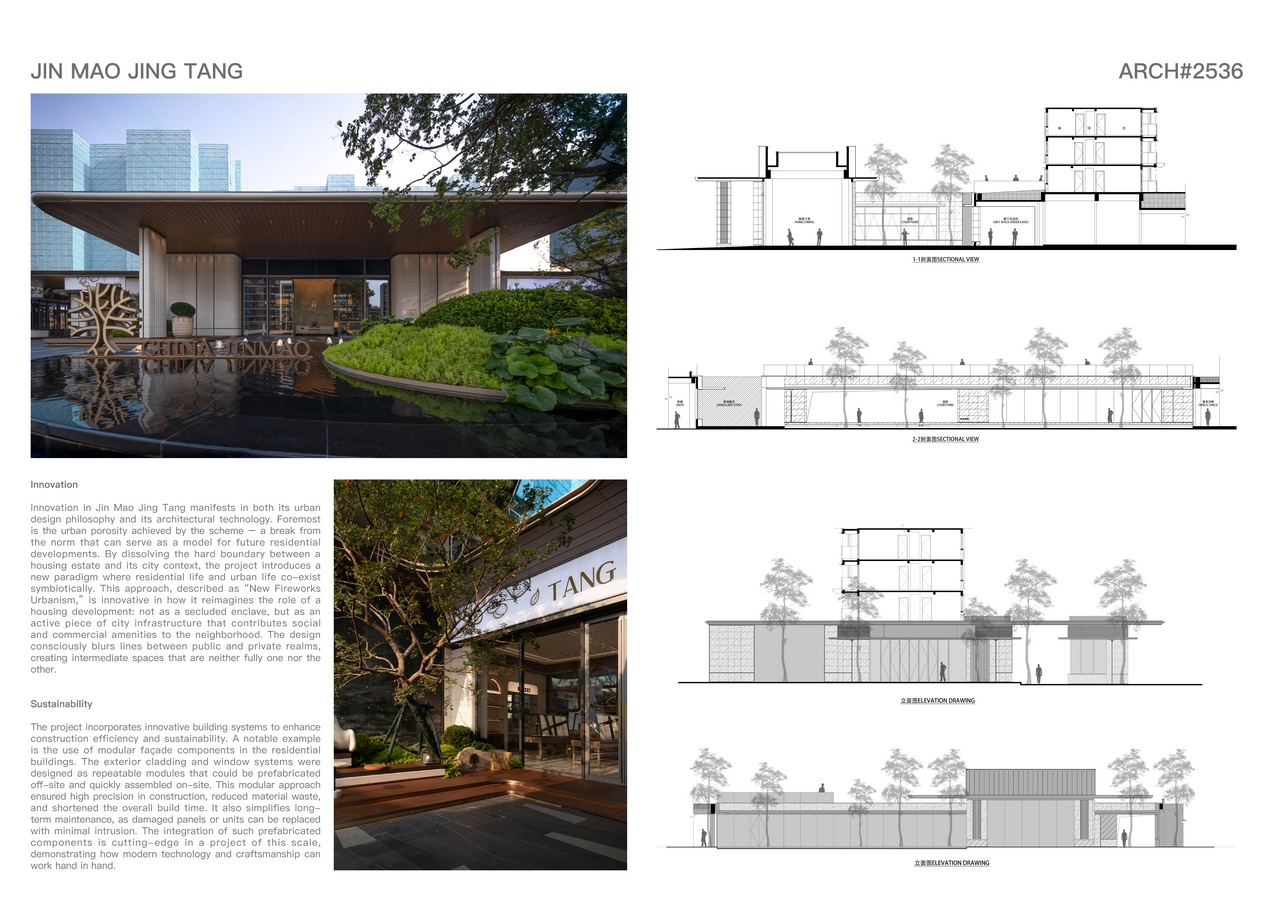
The master plan of Jin Mao Jing Tang replaces the traditional walled perimeter with a porous urban interface of meandering edges and interwoven public spaces. Along each street frontage, the building edges are artfully folded and setback to form winding pedestrian promenades rather than monolithic blocks. These folds accommodate lifestyle commercial “boxes” – small retail pavilions and cafés – that activate the street and serve both residents and the public. Continuous deep eaves run along these storefronts, forming a generous covered arcade. This creates a shaded “gray transition zone” between indoor and outdoor space, an architectural buffer where people can linger comfortably. The eaves and canopies not only reference the vernacular tradition of sheltering walkways, but also provide climatic comfort, reducing heat in summer and allowing sun in winter. In the pockets created by the undulating building line, three pocket parks are embedded as green oases. These small gardens, open to the public, bring nature to the street edge and offer places for relaxation and community events. Collectively, this edge strategy transforms the boundary of the project into a lively interface: it invites passersby into the site and blurs the line between the residential domain and the city beyond.
Deeper inside the development, a hierarchy of open spaces unfolds, embodying multi-layered shared spaces that foster community interaction at varying scales. The heart of the project is a central courtyard known as the “art valley” water garden, a serene landscaped court approximately 50 meters wide. This expansive courtyard is conceived as a metaphoric journey from city to forest: at its edges, urban activity from the perimeter streets gradually gives way to a more contemplative, natural atmosphere at the center. Lush plantings and a reflective water feature anchor this space, moderating the microclimate and providing visual and sensory respite. Residents can stroll along winding paths and across small bridges in this garden, experiencing a peaceful transition that mentally separates them from the city’s bustle. Surrounding the water garden, the residential blocks are arranged to enclose this inner “forest” while maintaining view corridors from the outside streets, so that glimpses of water and greenery are visible from the public realm.
Architecturally, the design solution emphasizes ceremonial spatial sequences that foster a sense of arrival and community identity. The main entrance to the complex is a grand plaza marked by a 10-meter-high and 30-meter-wide gateway, framed by a sweeping canopy with the presence of a boutique hotel entrance. This entrance pavilion draws inspiration from Chinese gate culture, reinterpreting the traditional city gate or courtyard entry in a contemporary form. Residents and visitors approach through this gateway under a bronze-clad canopy, experiencing a moment of threshold that is both sheltering and civic in scale. Beyond the gate, sightlines lead directly to the central water garden, aligning the entry axis with the heart of the project – a deliberate design move to immediately connect one’s arrival with nature and community space.
Innovation
Innovation in Jin Mao Jing Tang manifests in both its urban design philosophy and its architectural technology. Foremost is the urban porosity achieved by the scheme – a break from the norm that can serve as a model for future residential developments. By dissolving the hard boundary between a housing estate and its city context, the project introduces a new paradigm where residential life and urban life co-exist symbiotically. This approach, described as “New Fireworks Urbanism,” is innovative in how it reimagines the role of a housing development: not as a secluded enclave, but as an active piece of city infrastructure that contributes social and commercial amenities to the neighborhood. The design consciously blurs lines between public and private realms, creating intermediate spaces that are neither fully one nor the other.
Sustainability
1. Modular Façade System for Efficient Construction
The project adopts modular façade components to significantly enhance construction efficiency and sustainability. Exterior cladding and window systems were developed as repeatable units, prefabricated off-site and rapidly assembled on-site. This method improves precision, reduces material waste, shortens the construction timeline, and simplifies long-term maintenance, as individual panels can be replaced with minimal disruption.
2. Optimized Building Orientation and Shading Strategy
The overall layout and orientation were carefully calibrated to achieve a balanced relationship between sunlight and shade. Continuous eaves and deep canopies along the façades reduce direct solar gain at the ground level while creating comfortable semi-outdoor zones that promote natural ventilation throughout the site.3. Integrated Water Feature for Climate Moderation
At the center of the development, the water feature serves both aesthetic and environmental purposes. Beyond offering a visual focal point, it helps humidify and cool the air during Tianjin’s hot summers and functions as part of a rainwater management system that captures, stores, and recirculates water.

Project Details:-
Firm
Shanghai PTArchitects
Architect
Hu Qiao, Cheng Biao, Fu Yuelin, Wang Xingming
Project Name
Jin Mao Jing Tang
Project Category
Mixed-Use Built
Team
Hou Hanbing, Wang Shuocheng, Liu Tianci, Guo Jizhi, Wang Honglei, Jiang Xin
Project Location
Tianjin
Country
China
Photography ©Credit
©Shanghai PTArchitects

Shanghai PTArchitects: Founded in 2003, Shanghai PTArchitects strives to provide our clients with comprehensive and creative design solutions with the philosophy of “design for people, architecture for life” and the logic of exploring local culture, natural environment and the spirit of the time, creating spaces where the inhabitants live in harmony with the architecture. With more than a decade of growth, Shanghai PTArchitects has set up 10 offices in mainland China. The team consists of hundreds of architects and designers. Its practice includes the development of housing industry, commercial hotels, urban renewal, industrial planning, landscape and interior design and other fields.