

Aureum | Shanghai PTArchitects | International Residential Architecture Awards 2025
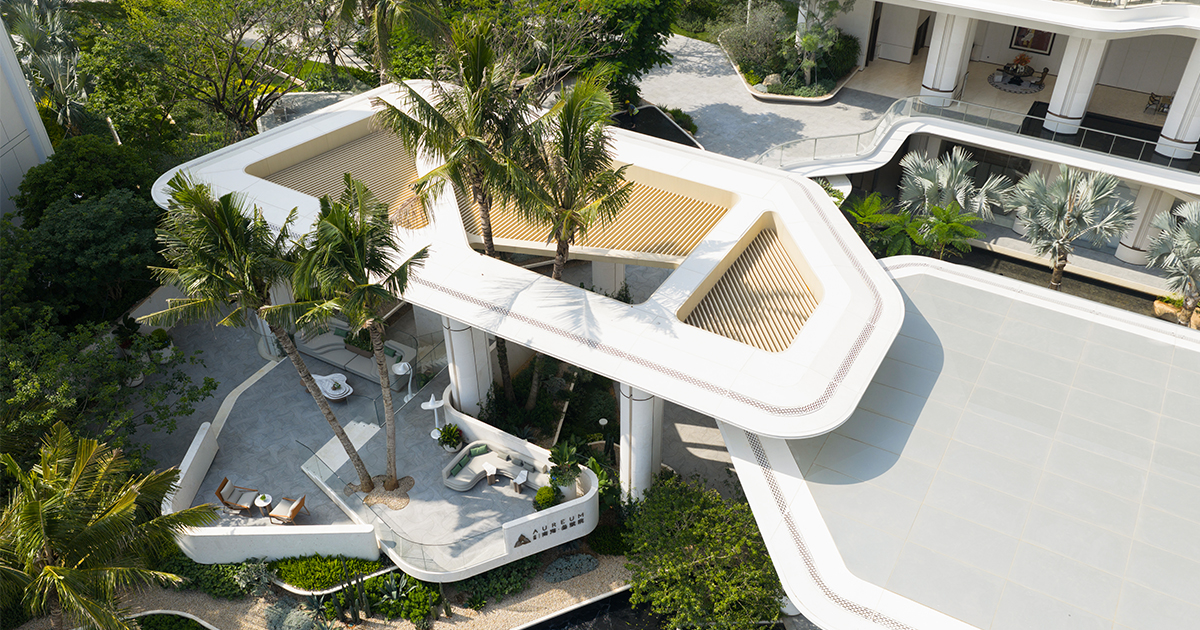
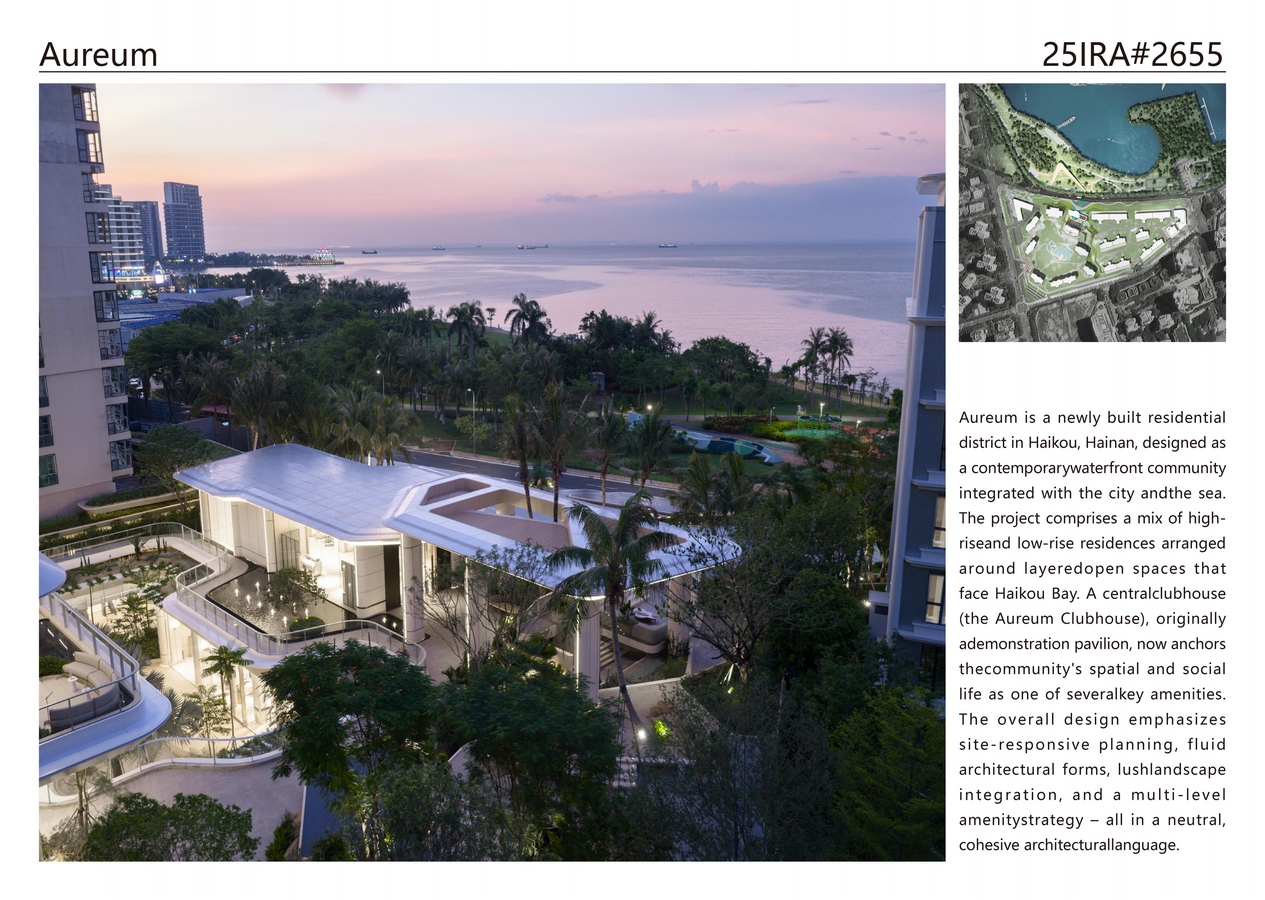
Shanghai PTArchitects: Winner of International Residential Architecture Awards 2025. Aureum is a newly built residential district in Haikou, Hainan, designed as a contemporary waterfront community integrated with the city and the sea. The project comprises a mix of high-rise and low-rise residences arranged around layered open spaces that face Haikou Bay. A central clubhouse (the Aureum Clubhouse), originally a demonstration pavilion, now anchors the community’s spatial and social life as one of several key amenities. The overall design emphasizes site-responsive planning, fluid architectural forms, lush landscape integration, and a multi-level amenity strategy – all in a neutral, cohesive architectural language.

Site Planning and Context
The development’s clubhouse anchors a central axis aligned toward Haikou Bay, with residential towers rising behind. The site occupies a prominent waterfront location in Haikou’s urban core, regarded as a “window” showcasing the city’s image on Haikou Bay. Masterplan strategies focus on connecting the city grid to the bay: an open central landscape axis extends through the site toward the coastline, preserving view corridors so that both residents and the broader public can continue to enjoy views of the oceanarchina.com. Even as a private residential development, the plan “gives space back to the city” by ensuring that these sightlines and pedestrian linkages remain open, effectively knitting the project into the larger Haikou Bay park systemarchina.com.
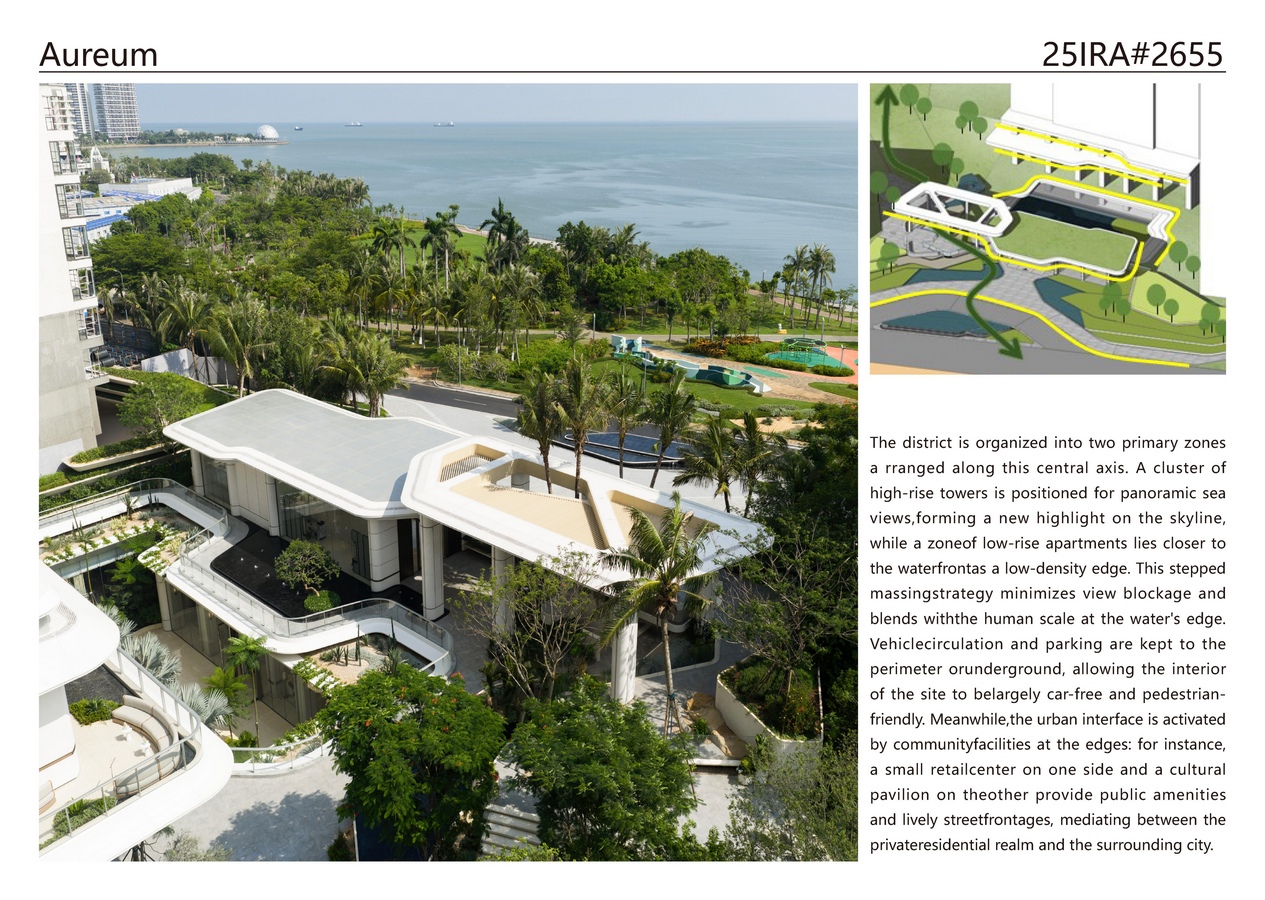
The district is organized into two primary zones arranged along this central axis. A cluster of high-rise towers is positioned for panoramic sea views, forming a new highlight on the skyline, while a zone of low-rise apartments lies closer to the waterfront as a low-density edge. This stepped massing strategy minimizes view blockage and blends with the human scale at the water’s edge. Vehicle circulation and parking are kept to the perimeter or underground, allowing the interior of the site to be largely car-free and pedestrian-friendly. Meanwhile, the urban interface is activated by community facilities at the edges: for instance, a small retail center on one side and a cultural pavilion on the other provide public amenities and lively street frontages, mediating between the private residential realm and the surrounding city.
Architectural Strategy
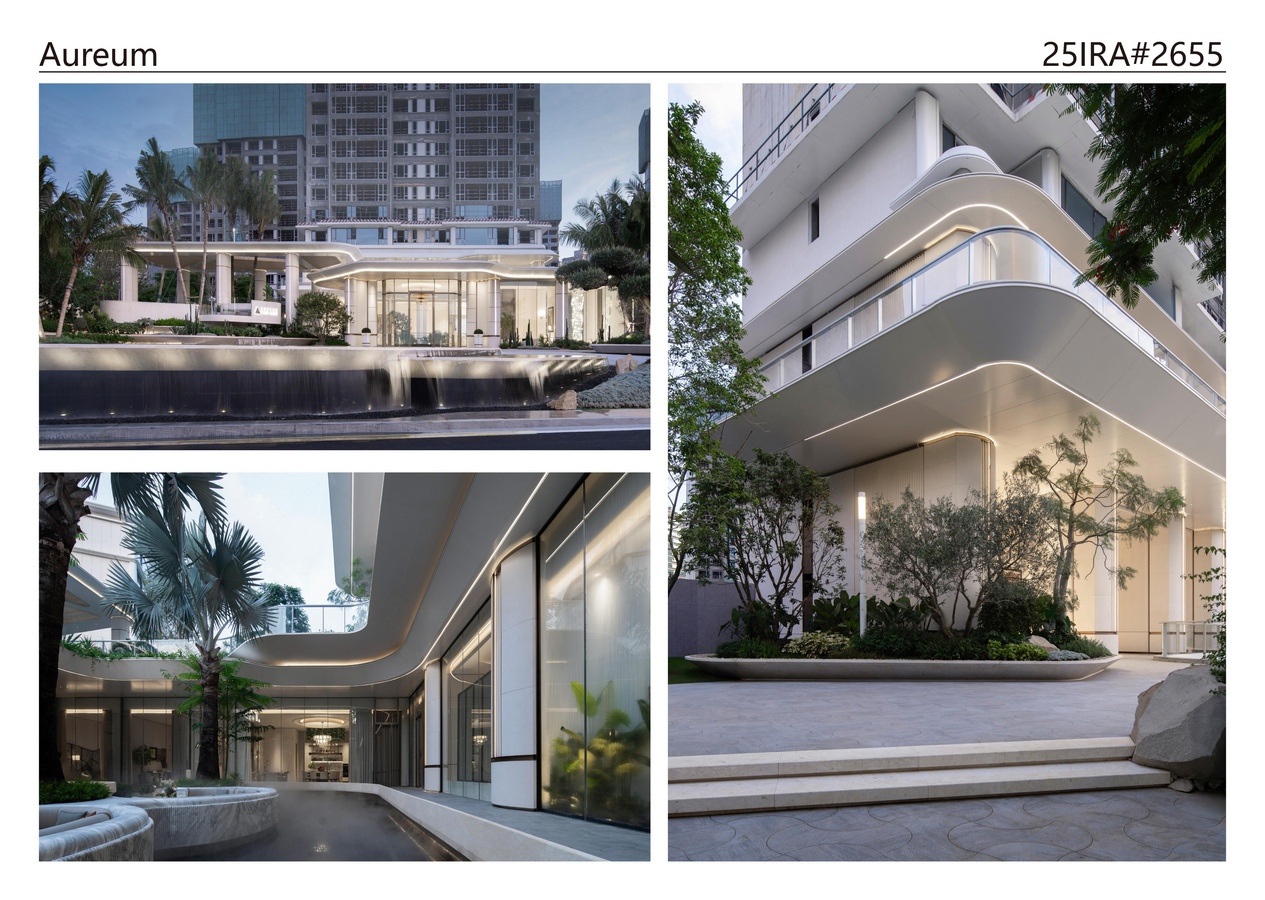
Architecturally, Aureum – Nanhai No.3 Courtyard adopts a fluid, modern design inspired by nautical forms and the coastal context. The site plan itself is streamlined like a yacht, with gentle curvilinear geometries that echo the rhythm of waves. Building forms feature sweeping curves and clean lines, creating a unified aesthetic across towers and low-rises. Facades are composed of pure-white aluminum panels and panoramic glass. This material palette not only gives a crisp, contemporary expression but also performs well in the tropical climate – the reflective white surfaces help mitigate heat gain under the Hainan sun, and extensive glazing captures the sea views with “ultra-wide-angle” vistas. The towers’ curved profiles and bright finishes catch shifting daylight, allowing the architecture to interact with sun and sea subtly over the course of the day.
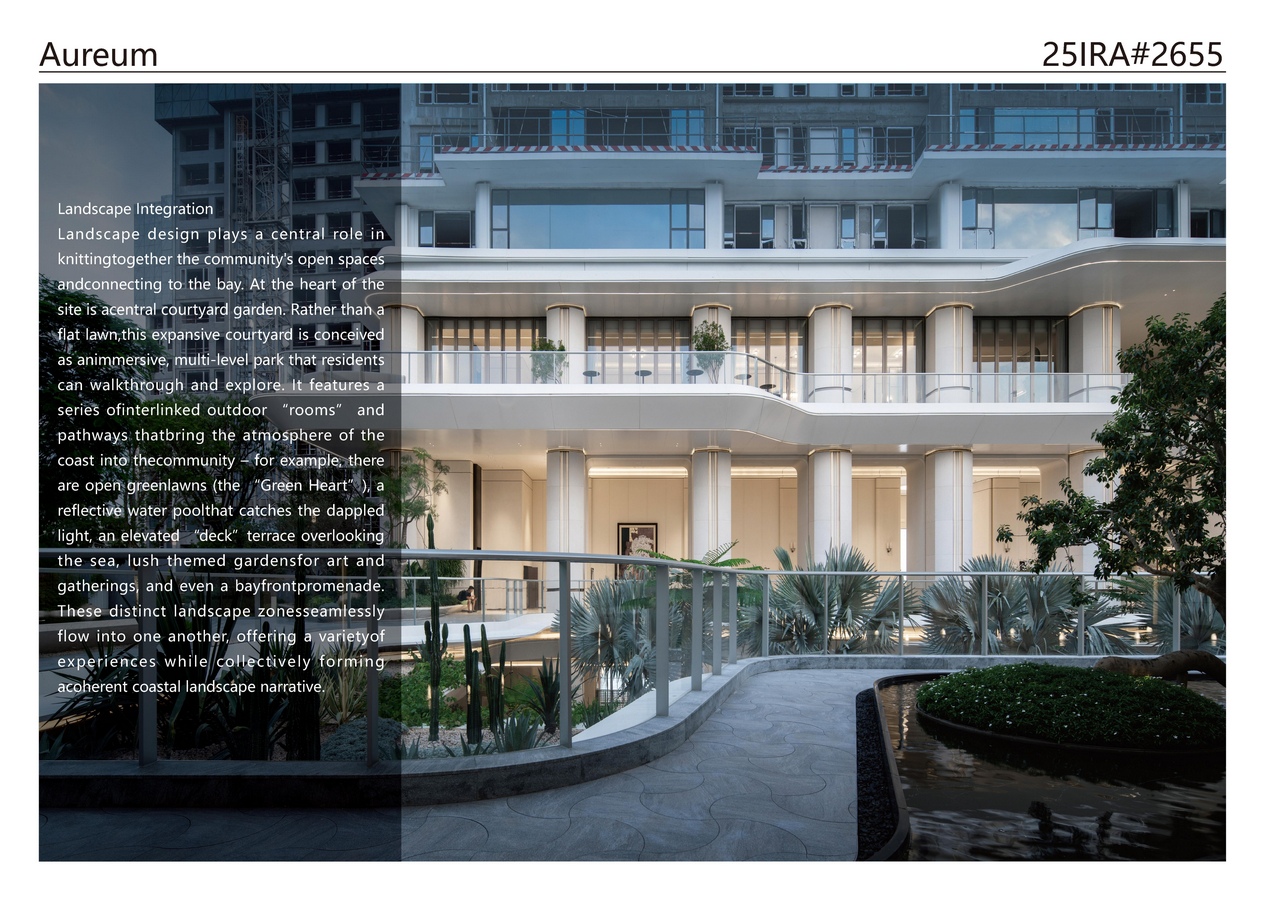
Environmental responsiveness is embedded in the design. Many of the high-rise buildings incorporate elevated open ground levels that create breezy, shaded communal spaces beneath the residences. This approach enhances natural ventilation through the site and provides sheltered outdoor areas for residents. The orientation of buildings maximizes cross-ventilation and frames view corridors toward Haikou Bay. Combined with the generous landscaping, water features, and overhanging roofs, these strategies improve thermal comfort and reduce the perceived density of the development. Overall, the architectural language remains neutral and elegant – avoiding overt ornament in favor of calm, rational forms that serve as a backdrop to the lush landscape and bay panorama.
Landscape Integration
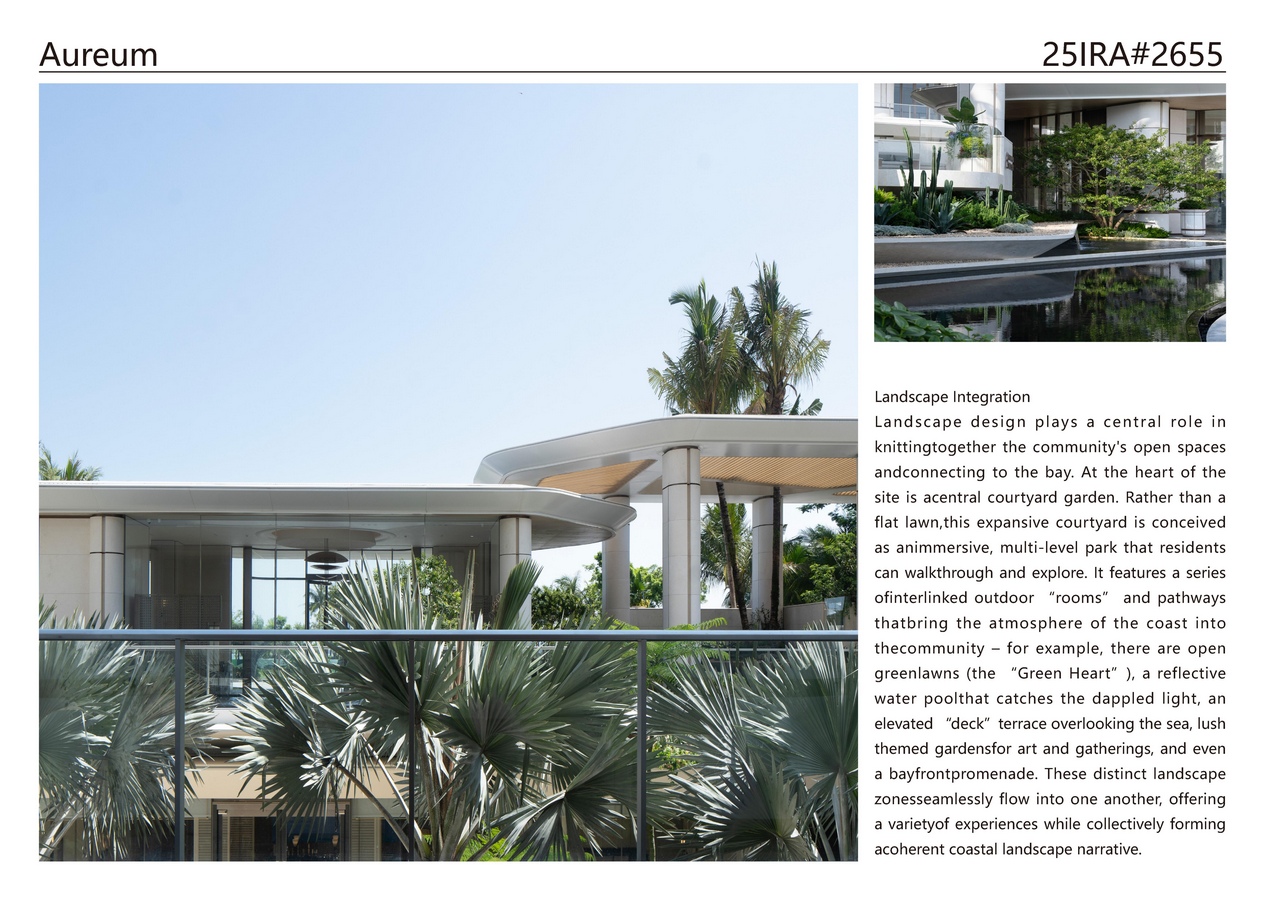
Landscape design plays a central role in knitting together the community’s open spaces and connecting to the bay. At the heart of the site is a central courtyard garden. Rather than a flat lawn, this expansive courtyard is conceived as an immersive, multi-level park that residents can walk through and explore. It features a series of interlinked outdoor “rooms” and pathways that bring the atmosphere of the coast into the community – for example, there are open green lawns (the “Green Heart”), a reflective water pool that catches the dappled light, an elevated “deck” terrace overlooking the sea, lush themed gardens for art and gatherings, and even a bayfront promenade. These distinct landscape zones seamlessly flow into one another, offering a variety of experiences while collectively forming a coherent coastal landscape narrative.
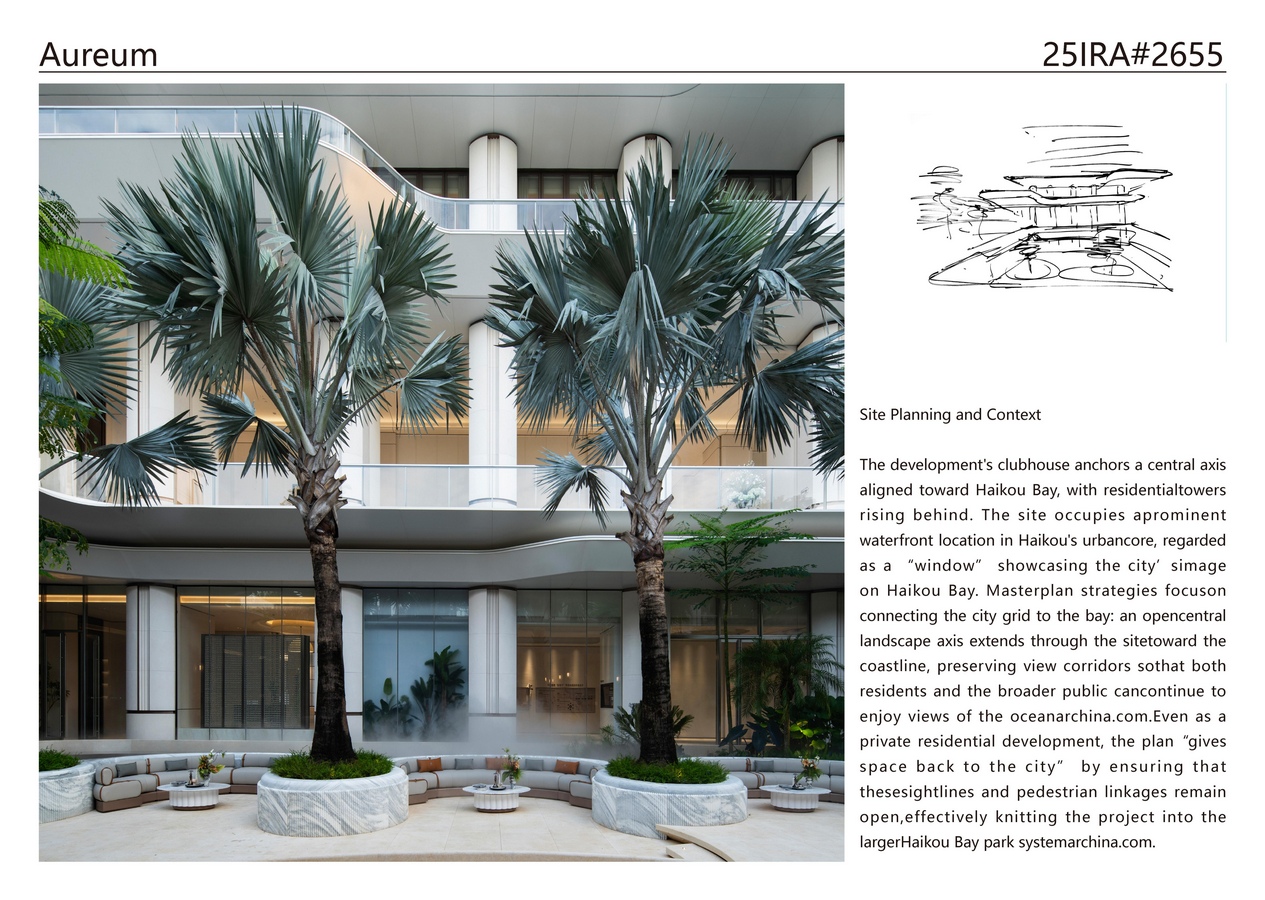
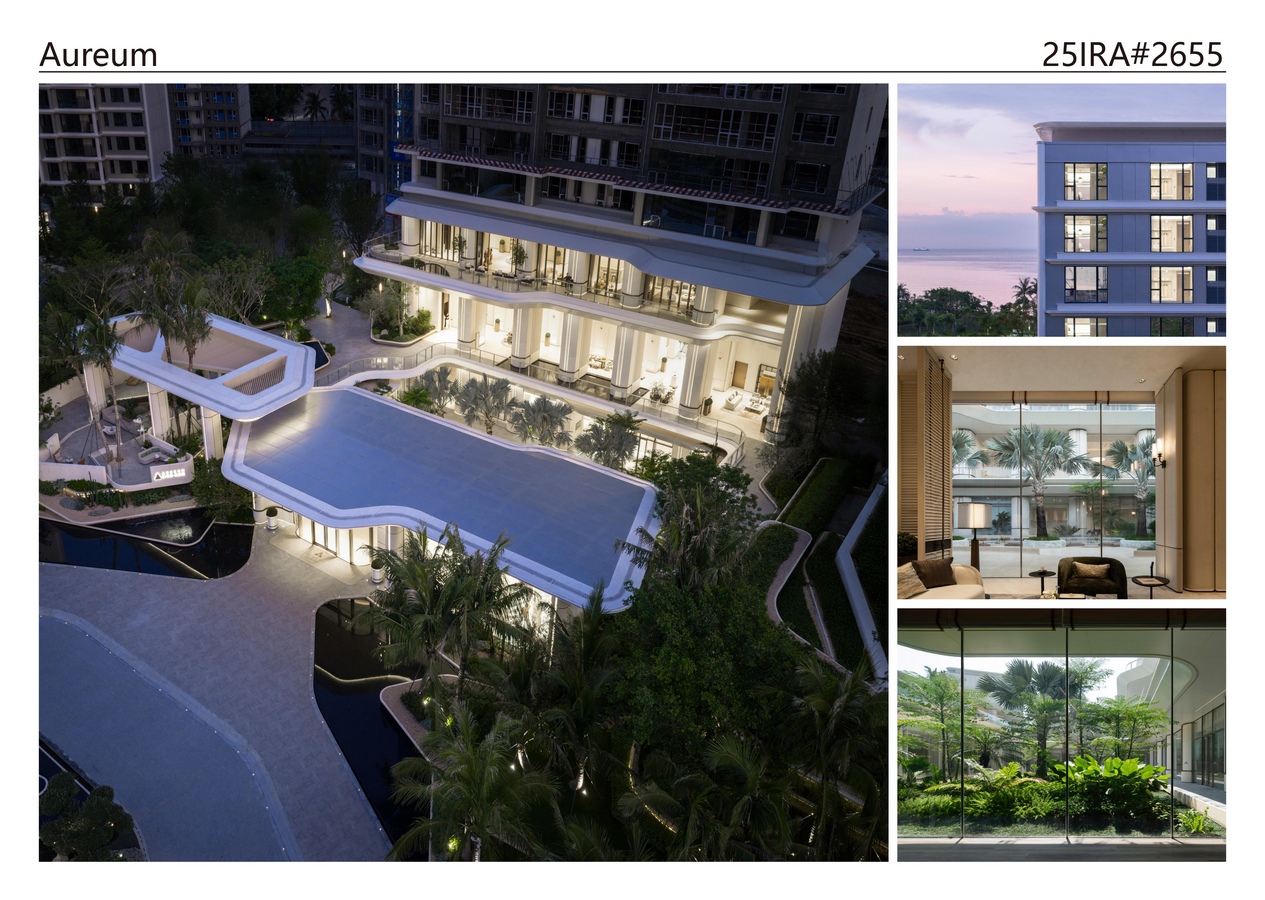
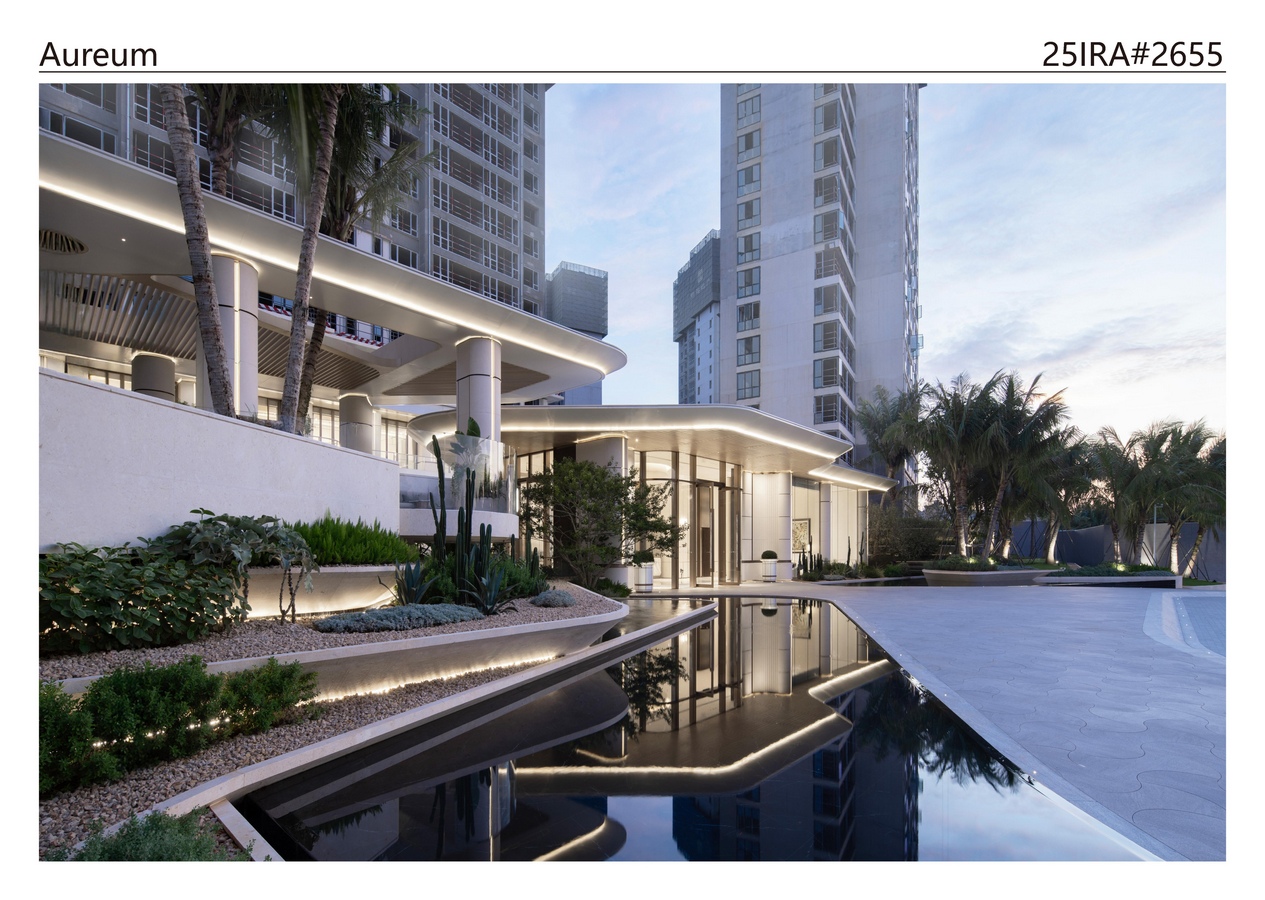
Lush planting and a sunken water courtyard blur the boundary between interior and exterior at the clubhouse. The planting strategy emphasizes native tropical flora and abundant greenery – roughly 40% of the site area is green space – which helps cool the microclimate and creates a resort-like ambiance. Tall palms, shade trees, and layered shrubbery provide privacy for ground-level residences and walking paths. The landscape is designed in layers: from public and communal zones like the central park and waterfront walk, to semi-private areas like pocket gardens by residential lobbies, and private outdoor terraces for individual units. This hierarchy of open space ensures each home enjoys access to nature while the community as a whole shares a grand common park. Importantly, the central axis and gardens are aligned with the adjacent public waterfront, visually extending to Haikou Bay and reinforcing the sense that the bay’s blue horizon is part of the community’s scenery.
Clubhouse and Amenities
Aureum’s community amenities are anchored by the Aureum Clubhouse, a signature two-level facility that was initially the project’s demonstration center. Located at the bay-facing end of the central axis, the clubhouse serves as a focal point for social and recreational life. Its design embodies the project’s inside–outside integration: a portion of the clubhouse is set around a sunken courtyard that brings light, water, and lush planting into the heart of the building. This sunken garden works as a semi-outdoor lounge where residents can relax in a cool, green enclave. Above, the clubhouse features an open-air or glazed pavilion (the “sky clubhouse”) that is elevated to capture sweeping views of the ocean and city skyline. By lifting this main gathering space, the design provides residents with a panoramic outlook and a unique venue for community events.
The development implements a “2 + 8” amenity strategy: two primary clubhouses (the sunken garden clubhouse and the sky-view clubhouse) plus a network of eight smaller themed spaces distributed throughout the neighborhood. These auxiliary facilities include intimate lounges, a reading room for children, an art exhibition space, a cigar bar, a small library or co-working nook, a community health station, and other flexible rooms. Scattered at strategic locations (for instance, in the base of residential buildings or along the central promenade), they ensure that leisure and social interaction nodes are always within easy reach. Each amenity space is crafted in the same architectural spirit – open, welcoming, and connected to greenery – so that using them feels like an extension of the home environment. Together, the clubhouse and these satellite amenities create an all-dimensional social landscape, spanning from the sunken garden up to the rooftop deck, and from the center of the site out to its edges. This arrangement balances residents’ privacy with opportunities for community engagement: one can find quiet retreat or join neighbors for activities without leaving the gated grounds.
Overall Design Impact
Aureum – Nanhai No.3 Courtyard illustrates a contemporary approach to coastal residential design that prioritizes spatial clarity and integration over stylistic ornament. By thoughtfully blending architecture, landscape, and amenities, the project achieves a harmonious environment that is both urban and resort-like. The site planning decisions – such as preserving a central open axis and keeping a low building density (Floor Area Ratio ~2.0) – have yielded a lush, park-like setting rare for a city-center development. This not only enhances the quality of life for residents, but also contributes to the public realm by maintaining visual openness and points of connection to the waterfront. The project’s curving white buildings and terraced gardens now form a distinctive yet context-sensitive landmark along Haikou Bay, marking the last piece of the bayfront with a design that embraces the sea views instead of walling them off.
In daily use, the design’s impact is palpable in the lifestyle it enables. Residents can sip tea with neighbors in the dappled shade of the sunken garden, host a small gathering on the elevated sea-view terrace, or stroll along the landscaped promenade at dusk while looking out to the bay. Such moments, facilitated by the development’s spatial layout, blur the boundary between ordinary life and vacation-like relaxation. In a neutral tone and grounded form, the architecture and landscape together create a quietly impressive setting – one that fosters community, responds to Haikou’s tropical coastal climate, and frames the beauty of Haikou Bay for all to enjoy.

Project Details:-
Firm
Shanghai PTArchitects
Architect
Shanghai PTArchitects
Project Name
Aureum
Project Category
Residential Built
Team
Sun Zhanhui, Liu Min, Jia Bin, Zhang Yu
Project Location
Haikou
Country
China
Photography ©Credit
©Archi-translator Studio

Shanghai PTArchitects
Founded in 2003, Shanghai PTArchitects strives to provide our clients with comprehensive and creative design solutions with the philosophy of “design for people, architecture for life” and the logic of exploring local culture, natural environment and the spirit of the time, creating spaces where the inhabitants live in harmony with the architecture.
With more than a decade of growth, Shanghai PTArchitects has set up 10 offices in mainland China. The team consists of hundreds of architects and designers. Its practice includes the development of housing industry, commercial hotels, urban renewal, industrial planning, landscape and interior design and other fields.