

Odeon 333 | DP Architects | World Design Awards 2025
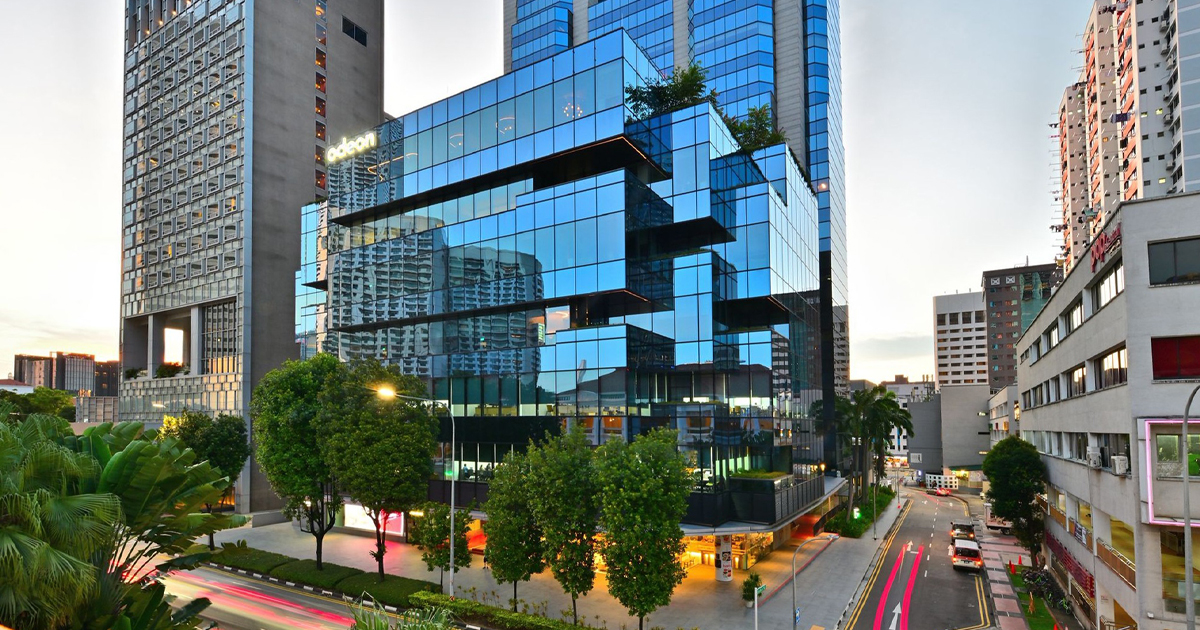
DP Architects: Winner of World Design Awards 2025. When UOL acquired the former KH-Kea site adjacent to Odeon 331 (formerly Odeon Towers), the project represented more than a land acquisition. It offered an opportunity to redefine continuity, connectivity and public life within one of Singapore’s most heritage-rich and densely built civic precincts. Although the two towers could not be physically merged, the design strategy deliberately binds old and new through their shared public realm, transforming what might have been an isolated commercial development into a cohesive, urban dialogue. Odeon 333 is not simply a stand-alone structure; it forms part of a larger narrative, one that links heritage, contemporary architecture and the pedestrian experience within a vibrant cityscape.

Urban Context & Massing
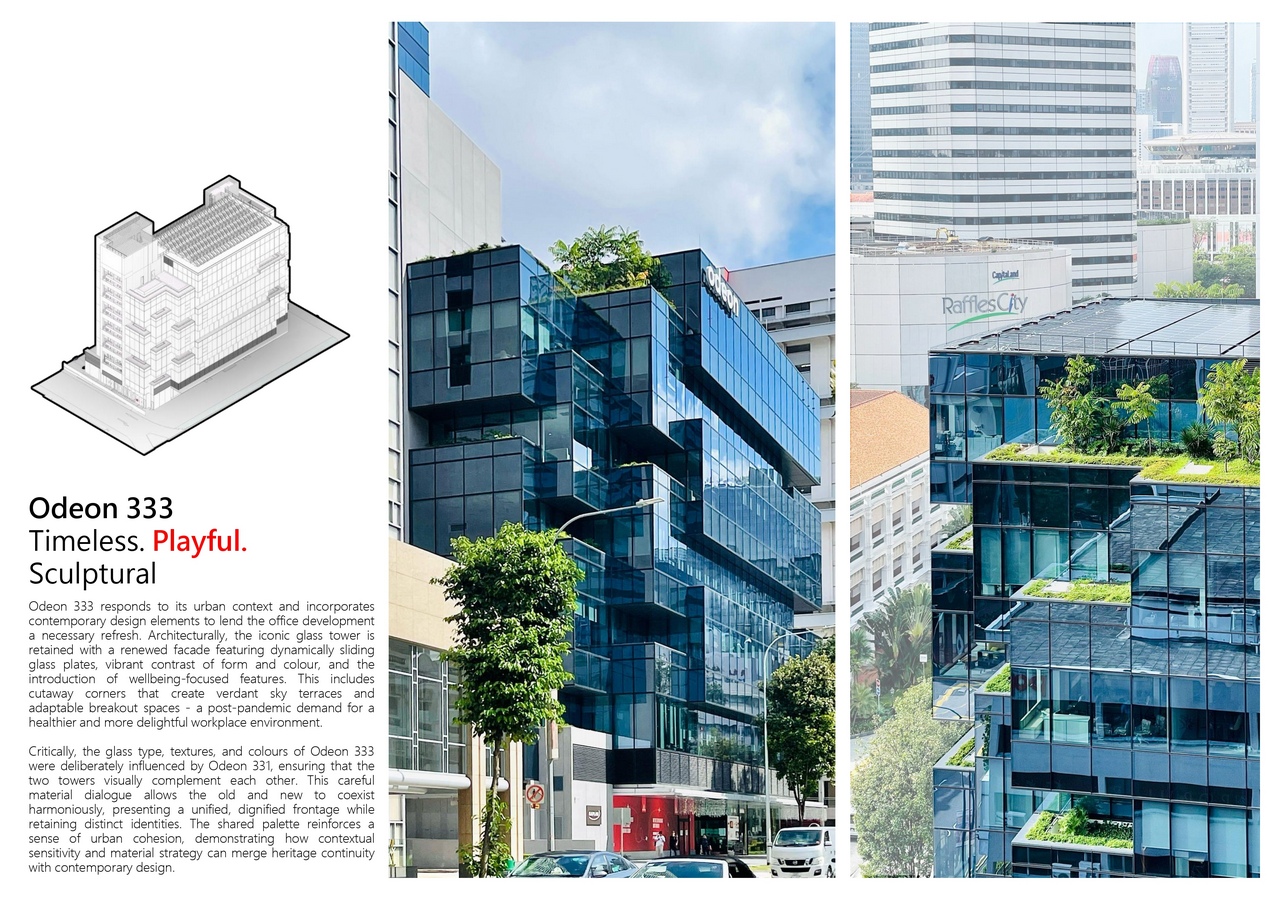
Odeon 333 is a stand-alone, seven-storey office and retail building fronting North Bridge Road, with approximately 7,430 m² of GFA. Its massing was carefully calibrated to respect the scale, profile and rhythm of its surroundings, particularly Odeon 331. While height and GFA restrictions could have limited its presence, the building’s design transforms these constraints into opportunities, employing non-GFA spaces and landscape interventions as primary design drivers rather than secondary afterthoughts.
Critically, the glass type, textures, and colours of Odeon 333 were deliberately influenced by Odeon 331, ensuring that the two towers visually complement each other. This careful material dialogue allows the old and new to coexist harmoniously, presenting a unified, dignified frontage while retaining distinct identities. The shared palette reinforces a sense of urban cohesion, demonstrating how contextual sensitivity and material strategy can merge heritage continuity with contemporary design.
GFA, POPS & Garden Terraces
Though capped at seven storeys by zoning and GFA controls, Odeon 333 exemplifies how spatial limitations can inspire architectural ingenuity. Non-GFA allowances—often seen as regulatory technicalities are elevated here as central elements shaping the building’s form, programme and public engagement.
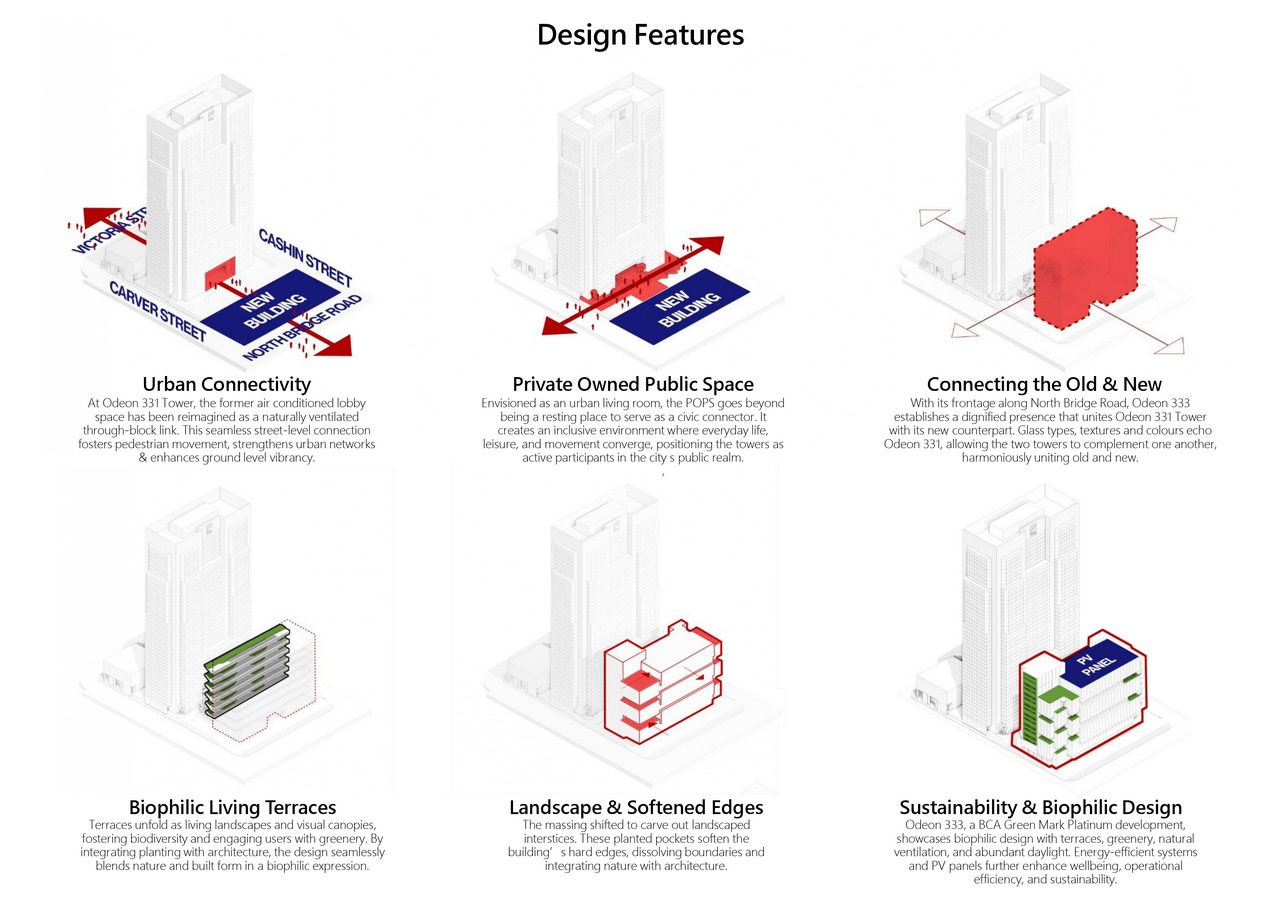
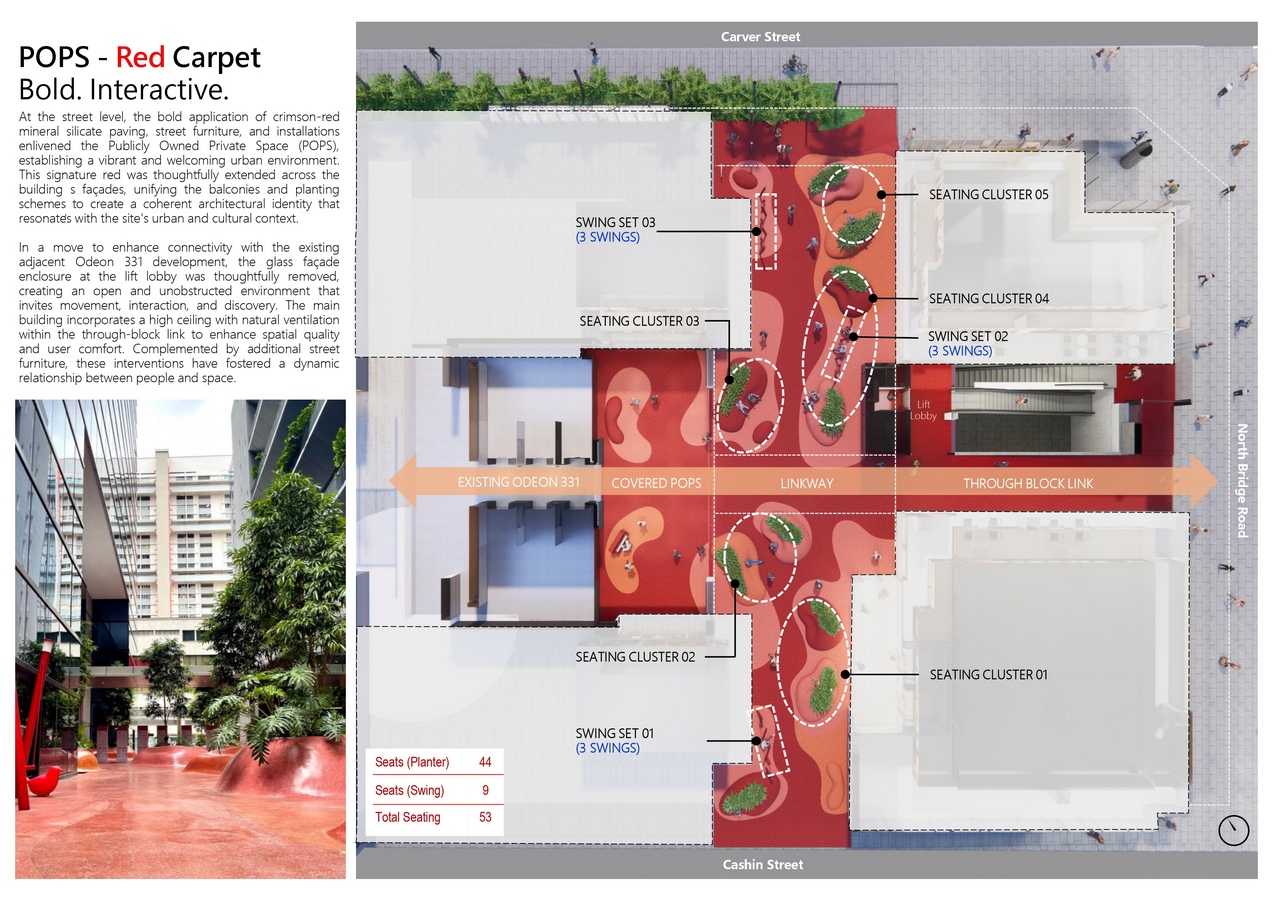
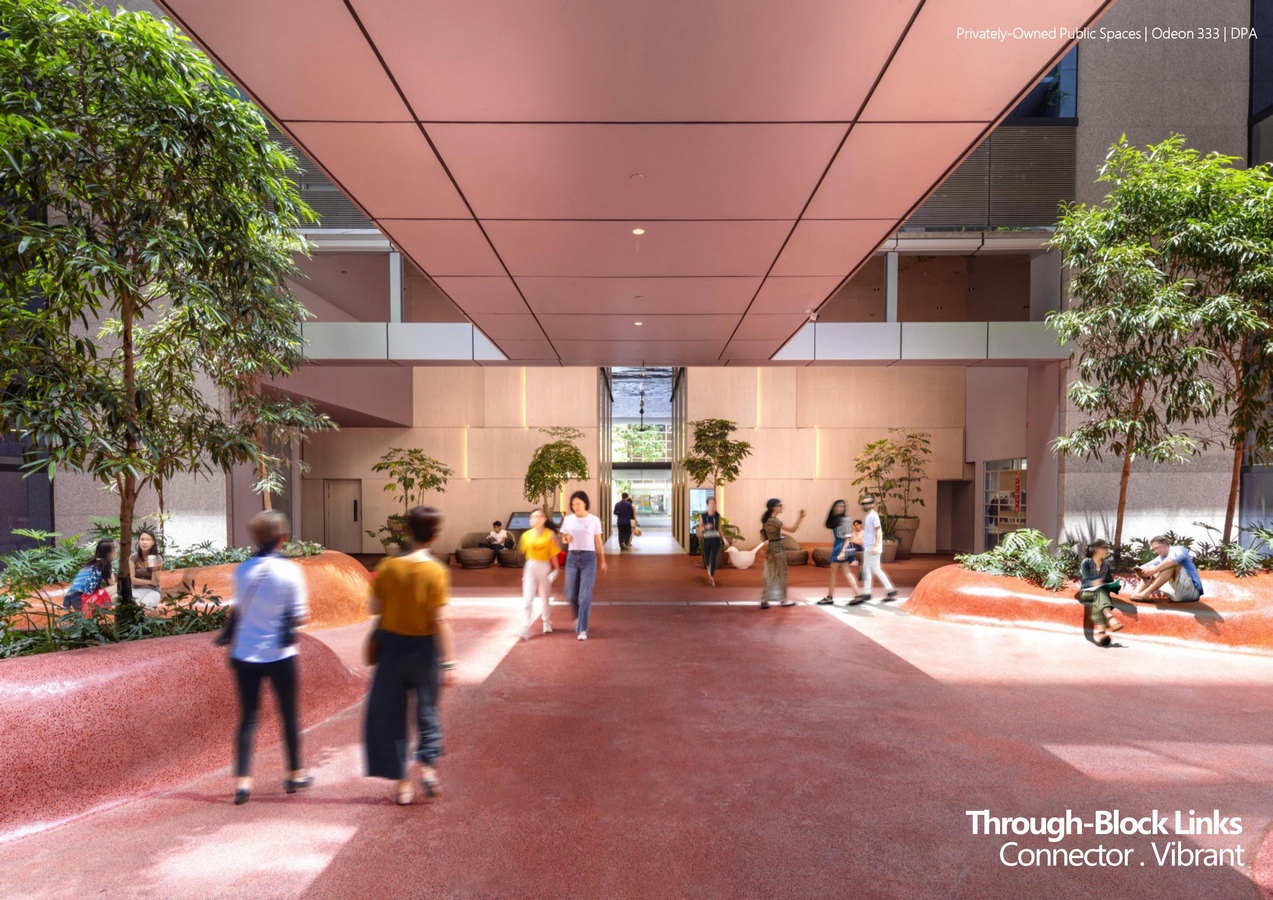
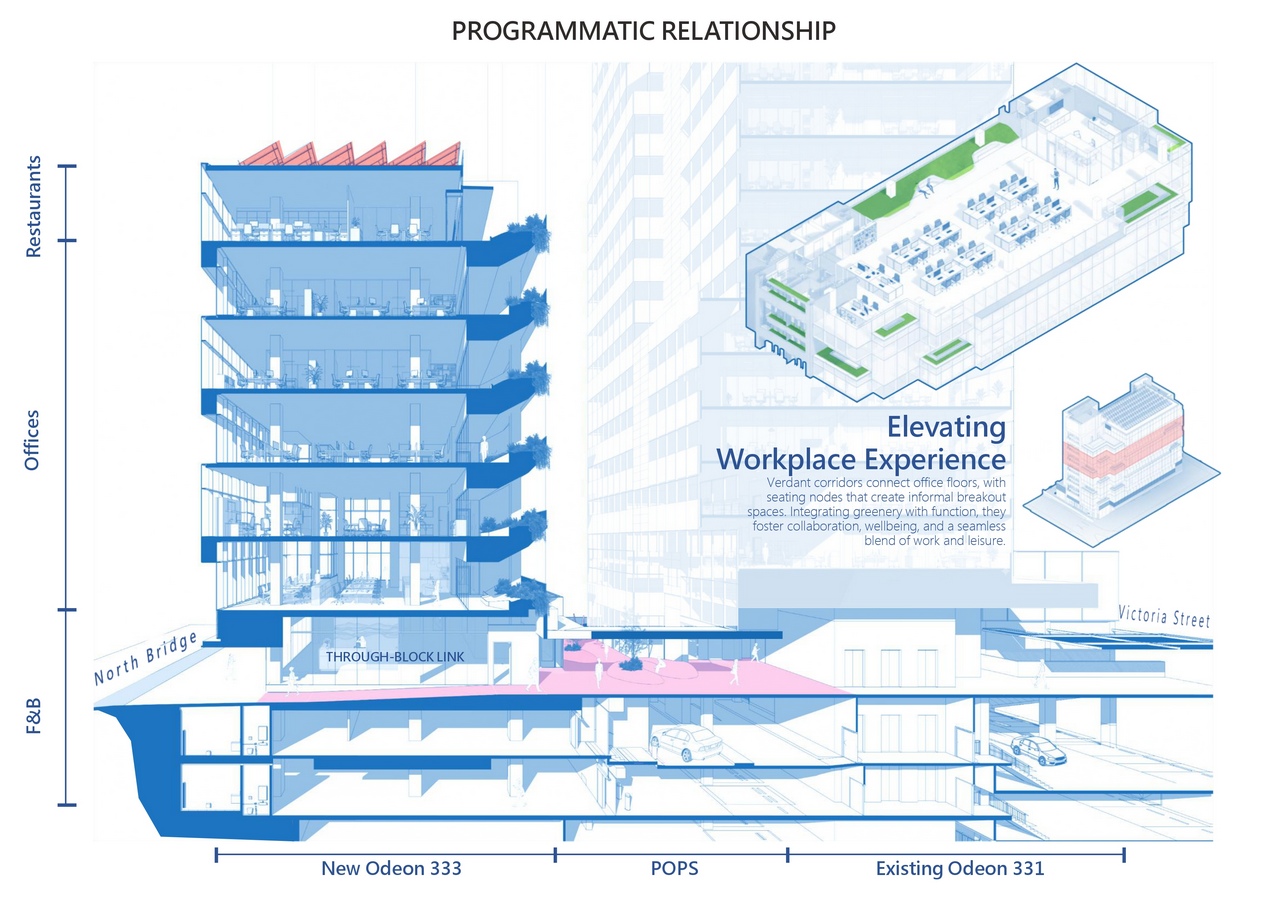
At the ground level, Odeon 333 leverages URA’s Privately-Owned Public Spaces (POPS) framework to deliver a generous, fully sheltered urban forecourt. This space is conceived as an active urban living room—open, visible and welcoming, extending the civic realm seamlessly through to the existing lobbies of Odeon 331 while remaining exempt from GFA calculations. By doing so, the design expands the public footprint without compromising leasable area, demonstrating strategic synergy between regulatory frameworks and urban generosity.
In an unprecedented intervention, the lift lobby of Odeon 331 was transformed into a naturally ventilated, free-flowing public space. Glass enclosures and air-conditioning were removed, allowing cross-wind ventilation and creating one of Singapore’s first office lift lobbies designed as an extension of the public realm. This innovation sets a precedent for rethinking transitional areas, typically private and enclosed as dynamic civic spaces.
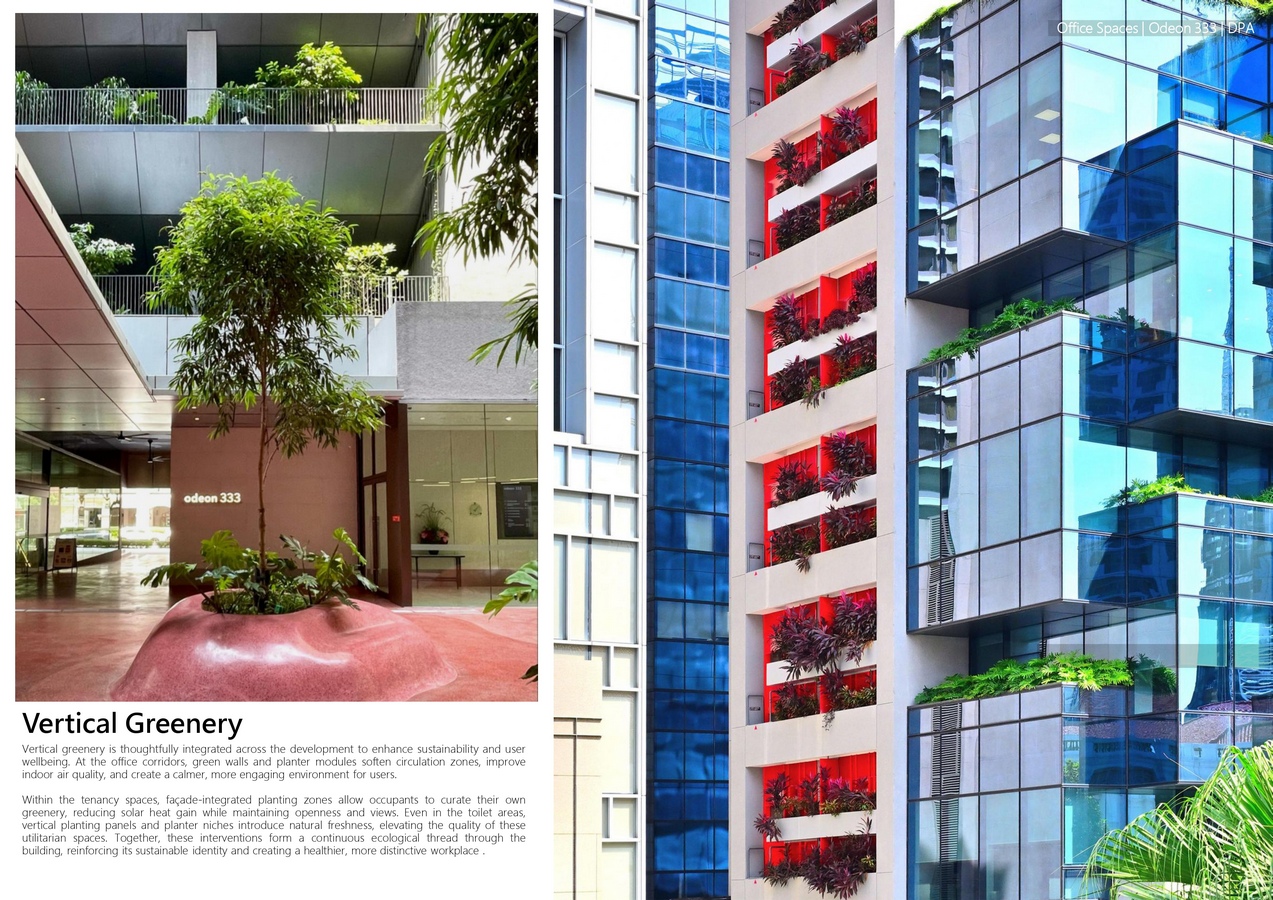
Above, each floor of Odeon 333 incorporates garden terraces that reimagine circulation corridors as outdoor, naturally ventilated gardens. They provide shade, foster biodiversity and offer informal breakout areas for tenants. Far from residual balconies, these terraces are intentionally programmed communal “breathing rooms”, blurring the boundary between interior and exterior and enriching the human experience at every level.
By orchestrating these GFA-free elements, POPS at the base, the reimagined lift lobby, and garden terraces above. Odeon 333 demonstrates how regulatory frameworks can be harnessed with clarity and ingenuity, amplifying both human experience and civic impact.
Public Realm & POPS Activation
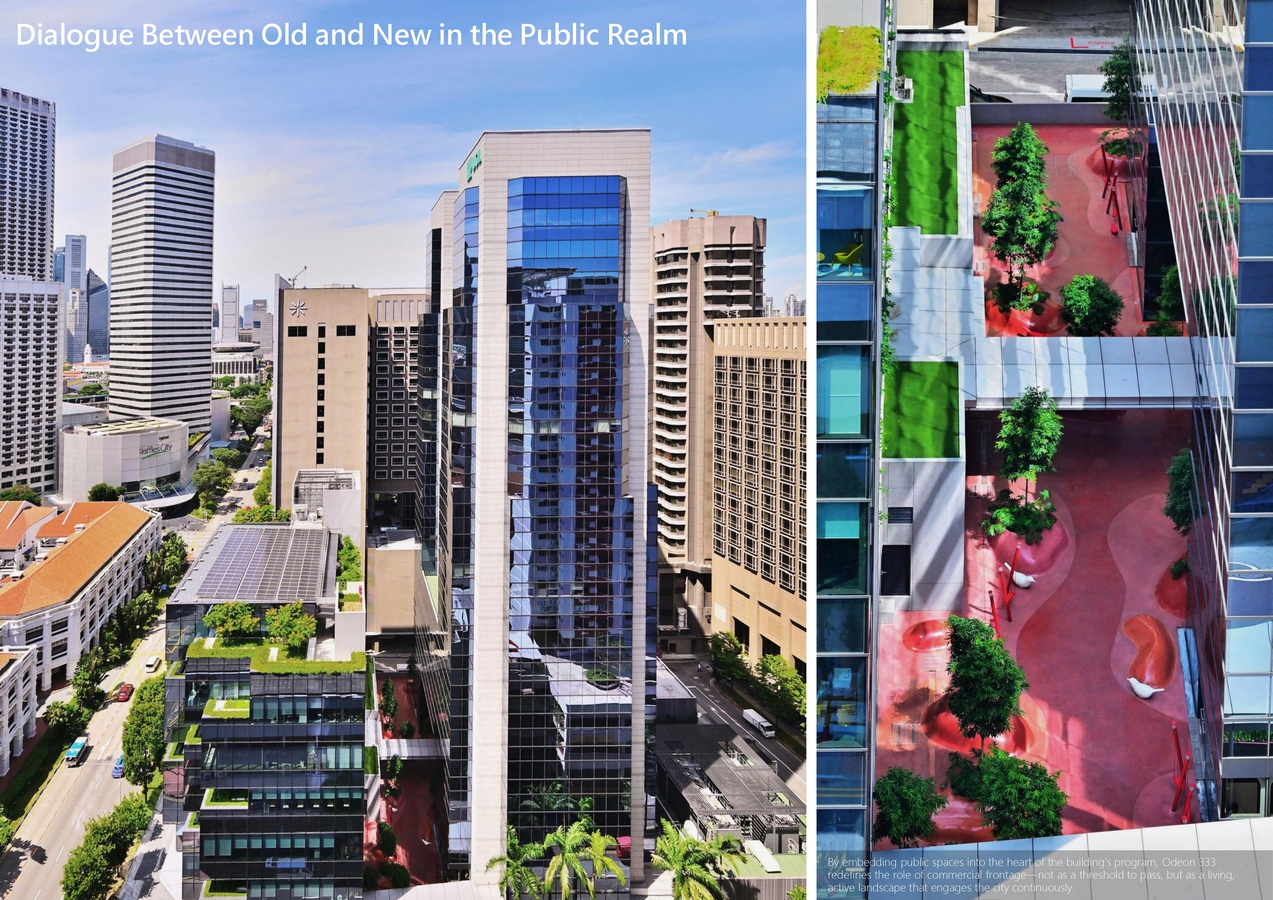
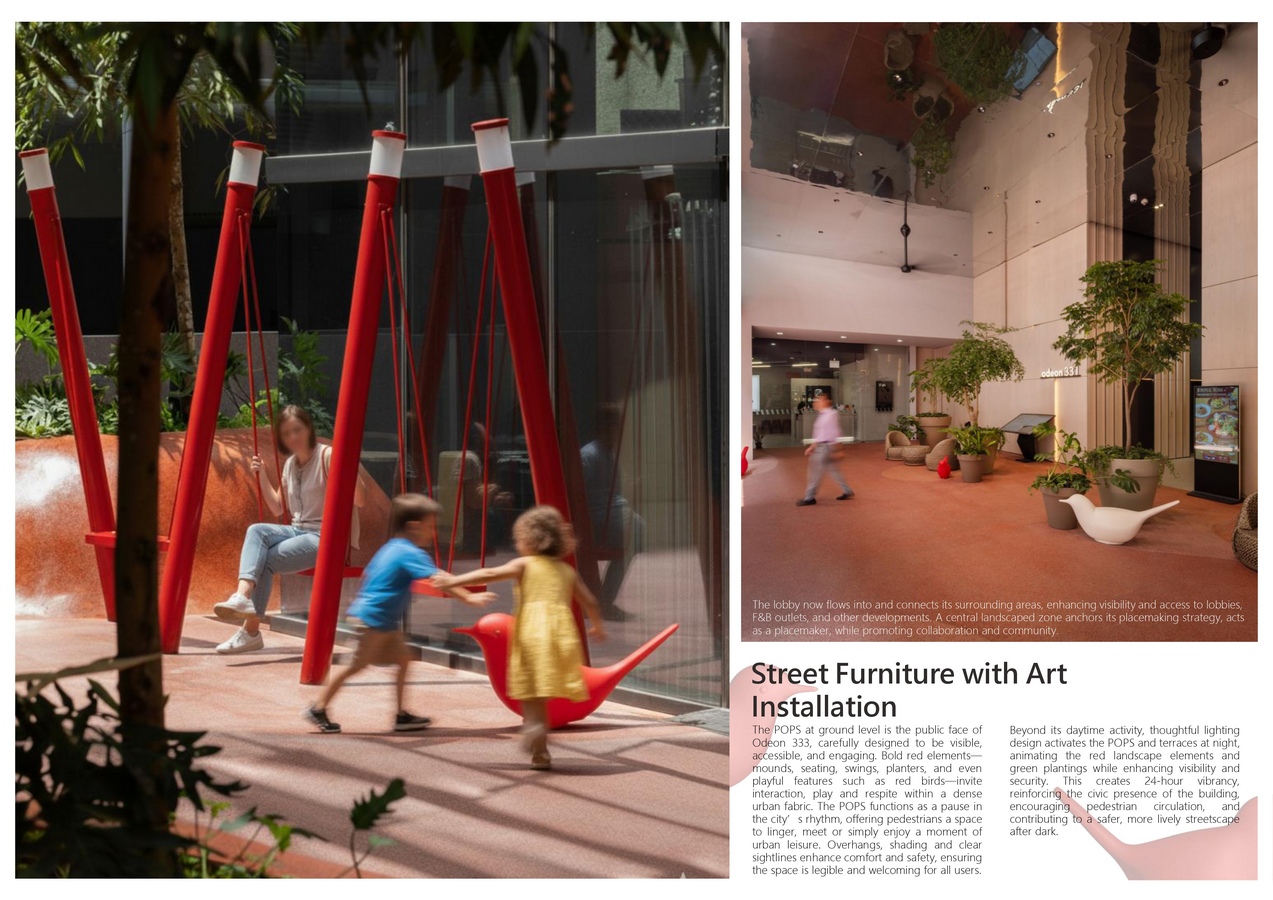
The POPS at ground level is the public face of Odeon 333, carefully designed to be visible, accessible, and engaging. Bold red elements, mounds, seating, swings, planters and even playful features such as red birds—invite interaction, play and respite within a dense urban fabric. The POPS functions as a pause in the city’s rhythm, offering pedestrians a space to linger, meet, or simply enjoy a moment of urban leisure. Overhangs, shading and clear sightlines enhance comfort and safety, ensuring the space is legible and welcoming for all users.
Beyond its daytime activity, thoughtful lighting design activates the POPS and terraces at night, animating the red landscape elements and green plantings while enhancing visibility and security, fostering 24-hour vibrancy. Reinforcing the civic presence of the building, encouraging pedestrian circulation, and contributing to a safer, livelier streetscape after dark.
By embedding public spaces at its core, Odeon 333 redefines the role of commercial frontage—not as a threshold to pass, but as a living, active landscape that engages the city continuously.
Materiality, Landscape & Softening Hard Edges
Odeon 333’s palette of glass, concrete and steel is softened and humanised through carefully integrated landscape. Planting is treated as an architectural material, not mere decoration. Green terraces, planters and overhanging edges are woven into the building, gradually cloaking the façade, blurring hard geometries and creating a transition from built form to nature.
The benefits of this approach are multi-dimensional:
- Climatic moderation: Shading and evapotranspiration reduce solar heat gain, cooling the building envelope and surrounding pedestrian areas.
- Ecological contribution: Vertical and terrace greenery supports biodiversity, attracting birds, butterflies, and pollinators, and enriching the urban ecosystem.
- Social and well-being impact: Landscaped corridors and terraces become restorative sanctuaries where office users can pause, breathe, and reconnect with nature.
Seasonal changes and cascading plantings animate the façade over time, ensuring the architecture remains dynamic, tactile, and engaging. The integration of greenery with bold POPS elements creates a striking contrast that frames playful, welcoming urban spaces. The use of inert mineral silicate surfaces to reduce heat gain and to resist dust and pollutants, as its breathability prevents mould and humidity damage, making the surface highly durable. Landscaping is central to the building’s identity, enhancing wellbeing while reinforcing civic and environmental contributions.
Sustainability & Biophilic Design
Odeon 333 has achieved Building and Construction Authority (BCA) Green Mark Platinum, the highest tier of Singapore’s Green Mark certification, reflecting leadership in energy efficiency, water conservation, indoor environmental quality and sustainable material use. This recognition underscores the project’s commitment to occupant wellbeing, operational efficiency and urban sustainability.
Key sustainable and biophilic features include:
- Biophilic integration: Garden terraces on every floor, vertical landscaping, and overhanging greenery improve air quality, provide thermal buffering and support urban biodiversity.
- Daylighting & glazing: Full-height windows and high-performance glazing maximise natural light, reduce dependence on artificial lighting and mitigate solar heat gain through shading, planted overhangs.
- Natural ventilation: Circulation corridors and lobby spaces, including the reconfigured Odeon 331 lift lobby, use cross-wind ventilation to minimise mechanical cooling, enhancing energy efficiency and occupant comfort.
- Energy-efficient systems: LED and sensor-activated lighting, efficient Heating, Ventilation, and Air Conditioning (HVAC) plant and raised flooring for underfloor services optimise energy performance.
- Mineral Silicate coating: The use of mineral silicate coatings on POPs floor and urban furniture to minimise heat gain was considered due to their composition of natural minerals like quartz and natural binders, which are abundant and non-toxic, resulting in zero to minimal Volatile Organic Compounds (VOCs) and no harmful outgassing.
Odeon 333 demonstrates how sustainability and biophilic design can coexist with commercial functionality, delivering measurable environmental outcomes while creating a healthier, more enjoyable experience for occupants and the broader public.
Wayfinding, Identity & Urban Presence
With an unbroken 50-metre frontage along North Bridge Road, Odeon 333 establishes a visible, dignified presence in a densely built civic district. The façade is conceived not merely as a boundary but as an extension of the public realm, actively engaging pedestrians. Carefully choreographed wayfinding and spatial sequencing make entrances, circulation paths, and public zones legible, ensuring intuitive navigation throughout the building.
Instead of enclosing communal areas, the POPS is integrated into the civic stage of Bras Basah and City Hall. Night-time lighting energises terraces and public zones, improving safety and fostering vibrant after-hours activity. The building serves as a 24-hour public landscape, supporting street life, pedestrian comfort and urban vitality, while showing how commercial architecture can enhance civic experience.
Anticipated Experience & Evolving Quality
Odeon 333 is designed to evolve gracefully over time. The plantings will mature, cascading over edges, softening hard geometries and creating textured, organic façades. Bold colours, precise forms and urban interventions will transition into dynamic, living compositions. Light, shadow and seasonal changes will continually animate the space, making the experience as much about atmosphere and engagement as it is about the built form.
Public spaces, terraces, and green corridors collectively provide multi-sensory experiences—from visual delight to thermal comfort and restorative quiet—offering respite in a dense urban environment. The building balances functional efficiency with human-centric design, making it a place remembered not only for its architecture but for its urban vitality and environmental responsiveness.
Conclusion
Odeon 333 exemplifies the power of thoughtful, context-sensitive design. By connecting old and new through public spaces, maximising non-GFA areas for civic benefit, the development integrates biophilic and sustainable strategies. It creates vibrant, legible and evolving urban experiences. In doing so, the project transforms a modest commercial envelope into a living civic asset.
It demonstrates how architecture can seamlessly weave buildings, people and nature into a coherent urban fabric, enhancing environmental performance, social well-being and visual harmony. Odeon 333 is more than a building; it is a model for the future of compact, dense and socially responsible urban development. Proving that even constrained sites can deliver outstanding civic, ecological and experiential value.

Project Details:-
Firm
DP Architects
Architect
Angelene Chan
Project Name
Odeon 333
Project Category
Office Building (Built)
Team
Angelene Chan, Yew Ze Neng, Foo Wei Min, Elsie Ong, Chong Mei Yan, Leonard Cheok
Project Location
Singapore
Country
Singapore
Photography ©Credit
©Arch-Exist, courtesy of DP Architects and Dalian Luneng Real Estate Co., Ltd

DP Architects is a leading multidisciplinary design practice in Asia with over 900 staff in 16 global offices and 8 specialist companies. Founded in 1967, it has a deep portfolio of works including Golden Mile Complex, Esplanade – Theatres on the Bay, Singapore Sports Hub and Our Tampines Hub. From Singapore, the ideas and methodologies of the design practice have since been applied to projects across 77 countries. Under its Green-Well-Tech thrust, DP delivers interdisciplinary design solutions at all scales for better-than-sustainable outcomes, contributing to sustainable development and a city’s long-term socio-economic resilience and vibrancy.