


ONE SINO RESIDENCES,Lize FBD | Shanghai PTArchitects | International Residential Architecture Awards 2025
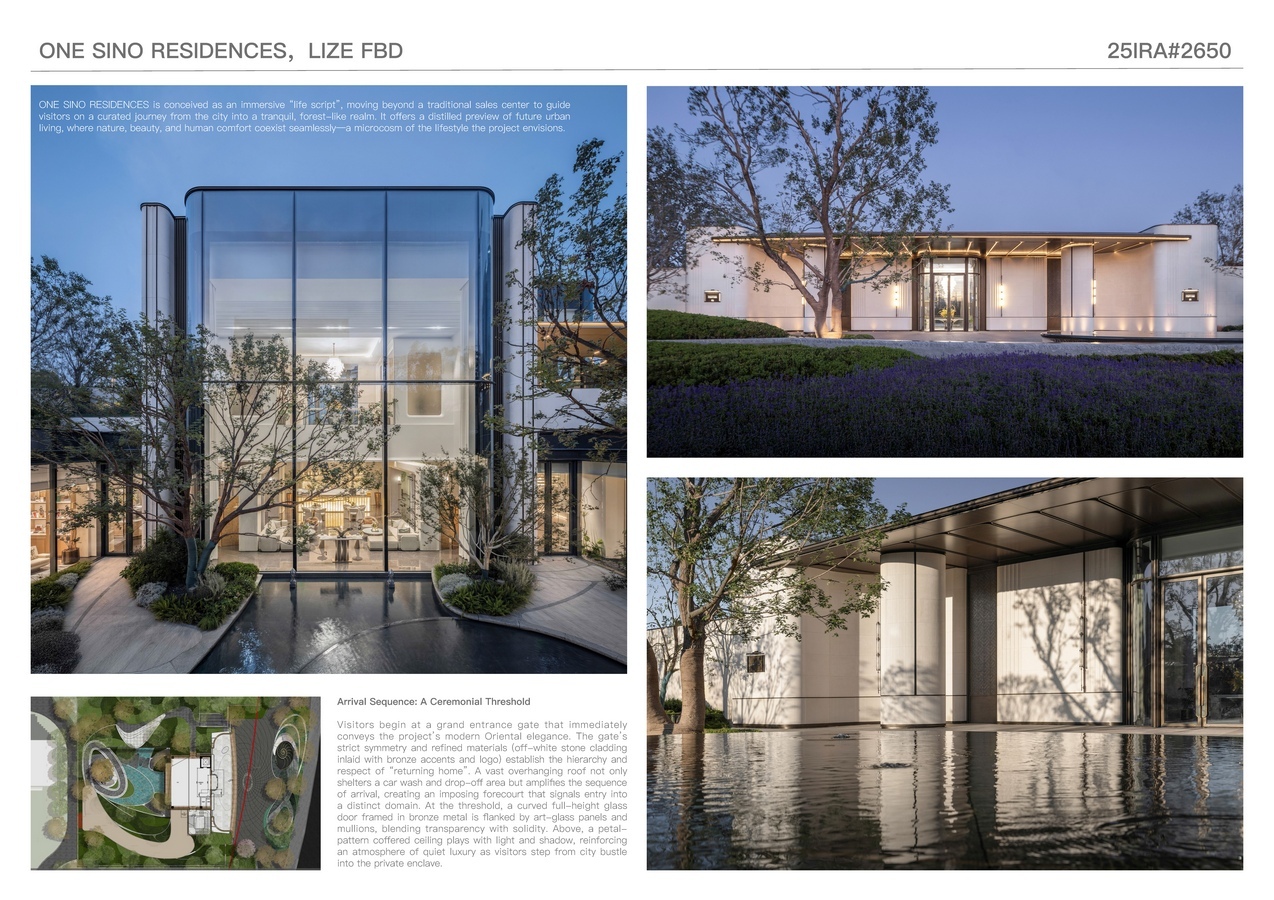
Shanghai PTArchitects: Winner of International Residential Architecture Awards 2025. ONE SINO RESIDENCES is conceived as an immersive “life script”, moving beyond a traditional sales center to guide visitors on a curated journey from the city into a tranquil, forest-like realm. It offers a distilled preview of future urban living, where nature, beauty, and human comfort coexist seamlessly—a microcosm of the lifestyle the project envisions.

Arrival Sequence: A Ceremonial Threshold
Visitors begin at a grand entrance gate that immediately conveys the project’s modern Oriental elegance. The gate’s strict symmetry and refined materials (off-white stone cladding inlaid with bronze accents and logo) establish the hierarchy and respect of “returning home”. A vast overhanging roof not only shelters a car wash and drop-off area but amplifies the sequence of arrival, creating an imposing forecourt that signals entry into a distinct domain. At the threshold, a curved full-height glass door framed in bronze metal is flanked by art-glass panels and mullions, blending transparency with solidity. Above, a petal-pattern coffered ceiling plays with light and shadow, reinforcing an atmosphere of quiet luxury as visitors step from city bustle into the private enclave.
Forest Oasis: Gardens and Clubhouses
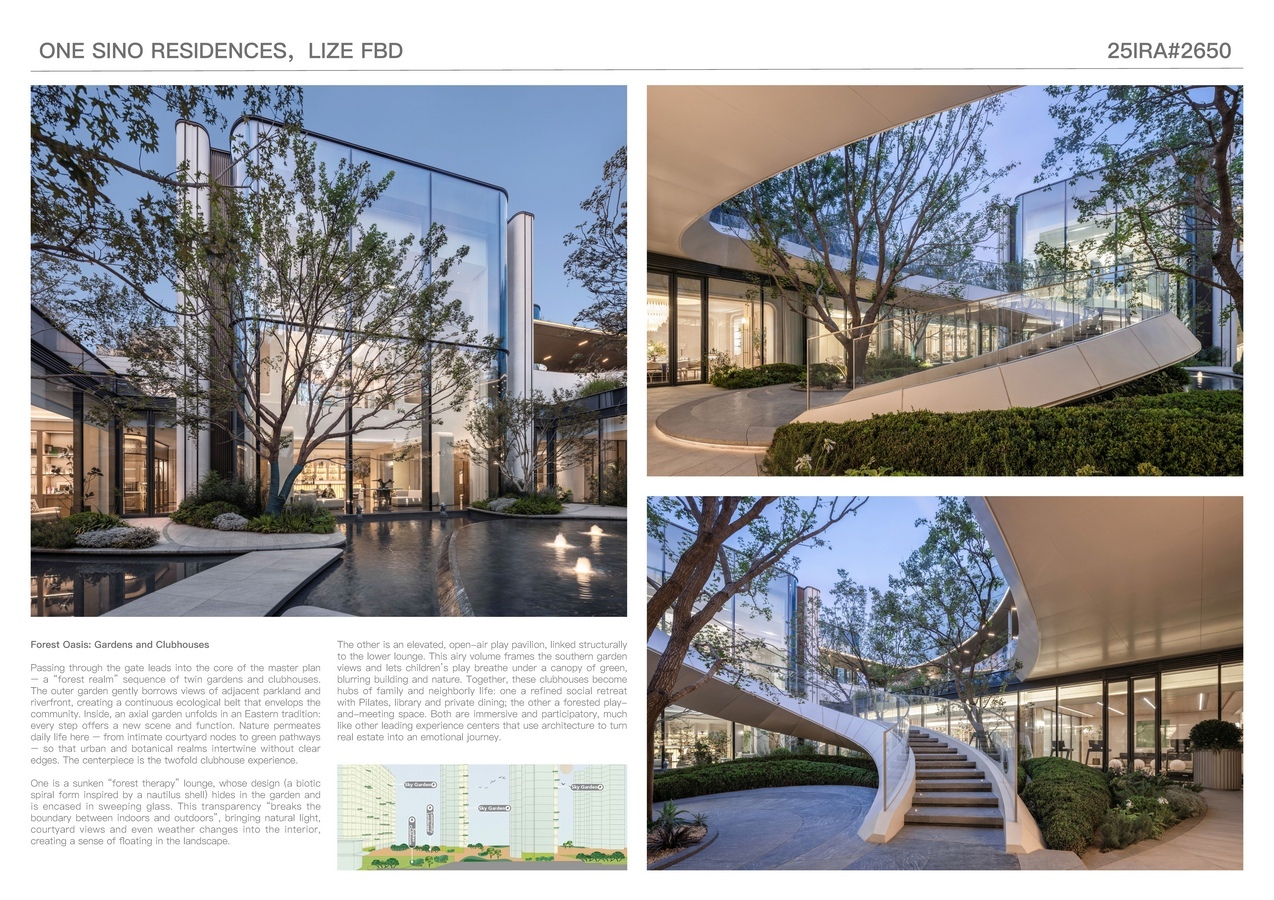
Passing through the gate leads into the core of the master plan – a “forest realm” sequence of twin gardens and clubhouses. The outer garden gently borrows views of adjacent parkland and riverfront, creating a continuous ecological belt that envelops the community. Inside, an axial garden unfolds in an Eastern tradition: every step offers a new scene and function. Nature permeates daily life here – from intimate courtyard nodes to green pathways – so that urban and botanical realms intertwine without clear edges. The centerpiece is the twofold clubhouse experience.
One is a sunken “forest therapy” lounge, whose design (a biotic spiral form inspired by a nautilus shell) hides in the garden and is encased in sweeping glass. This transparency “breaks the boundary between indoors and outdoors”, bringing natural light, courtyard views and even weather changes into the interior, creating a sense of floating in the landscape.
The other is an elevated, open-air play pavilion, linked structurally to the lower lounge. This airy volume frames the southern garden views and lets children’s play breathe under a canopy of green, blurring building and nature. Together, these clubhouses become hubs of family and neighborly life: one a refined social retreat with Pilates, library and private dining; the other a forested play-and-meeting space. Both are immersive and participatory, much like other leading experience centers that use architecture to turn real estate into an emotional journey.
Architectural Form and Materiality
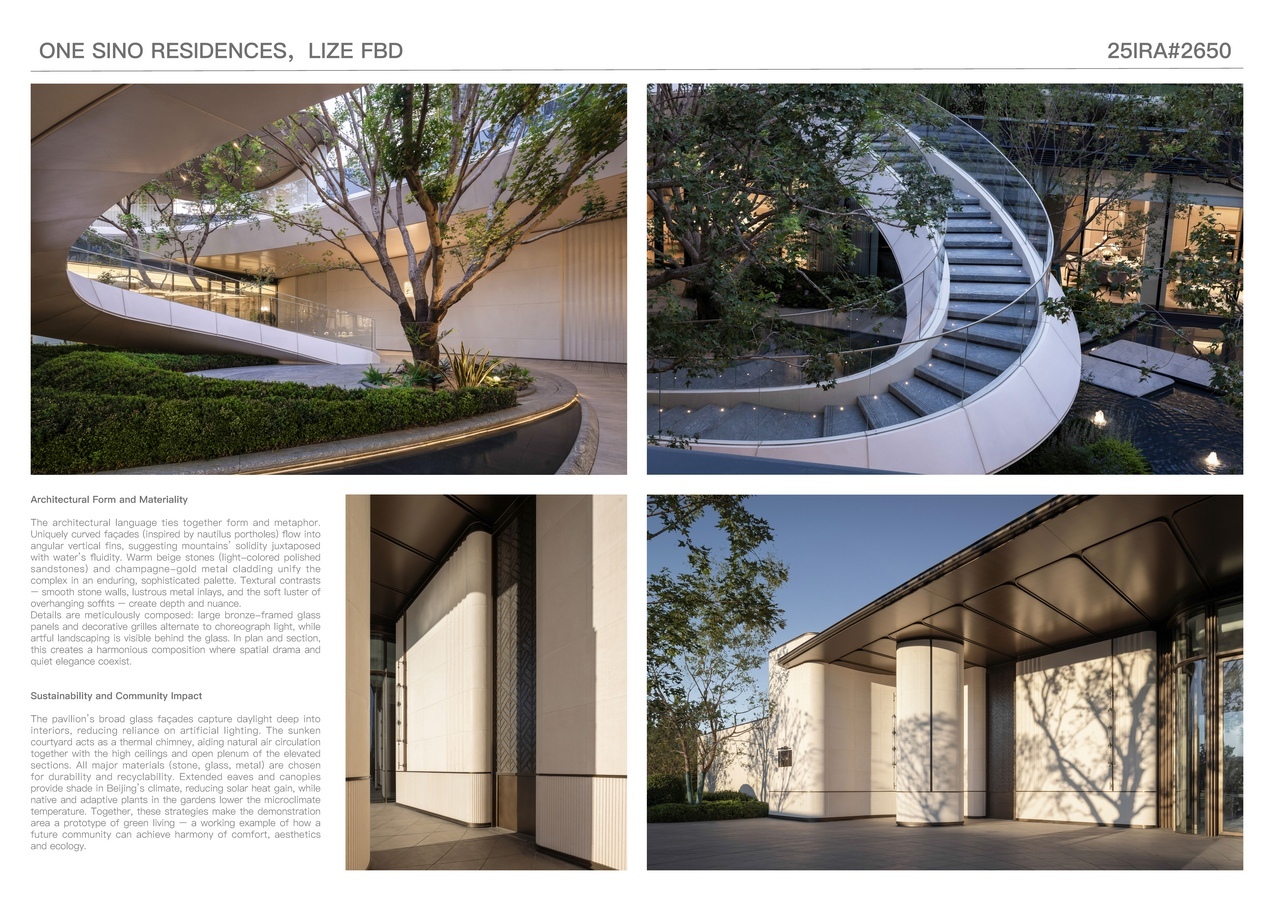
The architectural language ties together form and metaphor. Uniquely curved façades (inspired by nautilus portholes) flow into angular vertical fins, suggesting mountains’ solidity juxtaposed with water’s fluidity. Warm beige stones (light-colored polished sandstones) and champagne-gold metal cladding unify the complex in an enduring, sophisticated palette. Textural contrasts – smooth stone walls, lustrous metal inlays, and the soft luster of overhanging soffits – create depth and nuance.
Details are meticulously composed: large bronze-framed glass panels and decorative grilles alternate to choreograph light, while artful landscaping is visible behind the glass. In plan and section, this creates a harmonious composition where spatial drama and quiet elegance coexist.
Sustainability and Community Impact The pavilion’s broad glass façades capture daylight deep into interiors, reducing reliance on artificial lighting. The sunken courtyard acts as a thermal chimney, aiding natural air circulation together with the high ceilings and open plenum of the elevated sections. All major materials (stone, glass, metal) are chosen for durability and recyclability. Extended eaves and canopies provide shade in Beijing’s climate, reducing solar heat gain, while native and adaptive plants in the gardens lower the microclimate temperature. Together, these strategies make the demonstration area a prototype of green living – a working example of how a future community can achieve harmony of comfort, aesthetics and ecology.

Project Details:-
Firm
Shanghai PTArchitects
Architect
Sun Zhanhui, Liu Min, Fei Yurong
Project Name
ONE SINO RESIDENCES,Lize FBD
Project Category
Residential Under Construction
Team
Ma Ming, Li Yazhe, Ju Ze, Gao Xin, Li Xue, Li Zhenzhen, Li Xiaokang, Gao Xin
Project Location
Beijing
Country
China
Photography ©Credit
©Shanghai PTArchitects

Shanghai PTArchitects
Founded in 2003, Shanghai PTArchitects strives to provide our clients with comprehensive and creative design solutions with the philosophy of “design for people, architecture for life” and the logic of exploring local culture, natural environment and the spirit of the time, creating spaces where the inhabitants live in harmony with the architecture.
With more than a decade of growth, Shanghai PTArchitects has set up 10 offices in mainland China. The team consists of hundreds of architects and designers. Its practice includes the development of housing industry, commercial hotels, urban renewal, industrial planning, landscape and interior design and other fields.